
Steve Jobs on Connecting the Dots, Finding Love, and Facing Death
Steve Jobs on
Connecting the Dots, Finding Love, and Facing Death
How Three Stories Shaped One Visionary
Three decades of wisdom distilled into one commencement address that changed how we think about success, failure, and what it means to live well.
Adoption & Origins
Adopted as a child, Jobs saw himself as chosen, a belief that gave him confidence and independence throughout his life.
The Dropout
Leaving Reed College wasn't failure. It freed Jobs to follow his curiosity without the weight of expectations.
Calligraphy's Gift
A single humanities elective on typography planted seeds that bloomed years later in the first beautiful computer.
Apple's Launch
Starting Apple in a garage at age 20 with Woz, Jobs grew it into a $2 billion company with over 4,000 employees in just ten years.
The Firing
At 30, fired from his own company, Jobs faced the most painful rejection of his life, and found liberation in it.
NeXT & Pixar
After exile, Jobs reinvented himself through a new computer company and revolutionary animation studio, proving resilience.
The Mirror Ritual
For decades, Jobs asked himself each morning: "If today were my last day, would I do what I'm about to do?"
Cancer Diagnosis
Told he had three to six months to live, Jobs confronted mortality head-on, a visceral reminder that death is life's ultimate teacher.
The Path Forward
Stay hungry, stay foolish. Trust your heart and intuition. Let death guide your choices. This is how you live.
Steve Jobs begins his Stanford address by rewinding to before he was born: the story of his adoption. This was not a detail he treated lightly. His biological mother was a young, unwed graduate student who felt strongly that her son should be adopted by college graduates. When the arranged couple backed out at the last minute, Paul and Clara Jobs, neither of whom had graduated from college, adopted him, promising his birth mother he would one day go to college. This origin story, told with matter-of-fact candor, sets the tone for everything that follows: life rarely unfolds as planned, but the unexpected path can lead somewhere extraordinary.
From this foundation, Jobs traces a seemingly random path: Reed College, where he enrolled but soon felt adrift. Rather than pursue a traditional degree, he sat in on classes that interested him, including a fateful course on calligraphy. At the time, he couldn't imagine why. Calligraphy had no practical application. It wasn't a skill that would get him hired or make him rich. Yet he was mesmerized by the artistry of typography, by the marriage of aesthetics and function.
Then came the dropout decision. After six months, Jobs could no longer justify spending all of his working-class parents' savings on tuition he saw no value in. Yet this moment, which felt like a detour, proved to be the most crucial fork in his path. Freed from the obligation to take required classes, Jobs followed his genuine curiosities. He slept on friends' floors, returned Coke bottles for food money, and walked seven miles for a weekly meal at the Hare Krishna temple, all so he could drop in on the classes that fascinated him, like calligraphy.
Ten years later, when Jobs and Wozniak were designing the Macintosh, the calligraphy lesson emerged from the depths of his memory. Without that knowledge, which he had absorbed purely for its beauty, the Mac would never have had the proportionally-spaced typefaces and beautiful typography that would revolutionize personal computing. And since Windows just copied the Mac, it's likely that no personal computer would have them. The dot connected. But it could only be connected looking backward.
This is the essence of Jobs' first story: life is lived forward but understood backward. The temptation is always to optimize for the measurable, the credential, the safe choice. Yet the most meaningful connections in life often come from following genuine curiosity into places where there is no guarantee of payoff. Trust, Jobs argues, that the dots will somehow connect in the future. This requires faith: faith in your intuition, faith in the universe, faith that the path less traveled leads somewhere worth going.
"You can't connect the dots looking forward; you can only connect them looking backwards. So you have to trust that the dots will somehow connect in your future."
Steve Jobs, Stanford Commencement Address, 2005The second story is Jobs' pivot into the present tense. If the first story teaches that you must trust the future, the second story shows what happens when you actually achieve the future you imagined. At twenty, Jobs and Wozniak started Apple in a garage. Within ten years, Apple had grown from two young men tinkering with electronics to a multi-billion-dollar company with thousands of employees. By thirty, Jobs had everything the world tells you to want: wealth, power, status, and the adoration of millions. He had won.
But then came the fall. Jobs hired someone he thought was very talented to run the company with him, but their visions diverged. When they had a falling out, the board of directors sided with the other man. At 30, Jobs was out. How can you get fired from a company you started? As it turns out, quite easily. The company he founded, the company that was his life's work, the company that had become his identity. The story Jobs tells is raw and honest. He was devastated. He had been publicly humiliated. He felt like a failure despite all his external success. More than that, he had lost his sense of purpose. What was he without Apple? Who was he if not the founder of one of the world's greatest companies?
This is where the second story diverges from typical narratives of success. Jobs doesn't bounce back immediately. He doesn't simply launch a new venture and move on. Instead, he falls. He admits, without shame, that he even thought about running away from the Valley. He had failed publicly. He was ashamed. Yet it is in this darkness that Jobs discovers something more valuable than the success he had lost.
Freed from his identity as "the founder of Apple," Jobs began to rebuild his life piece by piece. He started NeXT Computer, a new venture that didn't achieve the commercial success of Apple but represented an intellectual achievement. He started Pixar, which would go on to create the world's first computer-animated feature film, Toy Story. Yet these ventures weren't about making another billion dollars. They were about rediscovering what he loved.
The key insight Jobs shares is this: losing everything forced him to find what truly mattered. When you have everything, success can become hollow. You chase status because you've tasted it. You optimize for metrics because you've mastered them. But loss strips away these incentives. It forces you to ask: what do I actually love? What would I do even if no one knew? What matters now that I cannot trade my way back to my old life?
Jobs spent these years rebuilding himself not through achievement but through love. He fell in love with an amazing woman who would become his wife, Laurene. He loved the craft of animation and technology for their own sake, not for the accolades they would bring. He loved his friends and mentors. And crucially, he learned to love himself again, not as a billionaire founder, but as a person.
The Rise & Fall at a Glance
Jobs' second story covers a turbulent decade of his life. His rise was meteoric: founding Apple at twenty with minimal resources and transforming it into a multi-billion-dollar empire. But his fall was equally dramatic. By his early thirties, fired from his own company, Jobs faced a reckoning that most successful people never experience. He had tasted both triumph and humiliation. And he chose to learn from the humiliation.
The philosophical shift here is profound. Jobs moved from asking "How do I win?" to asking "What do I actually love?" This distinction matters because it reveals the difference between ambition driven by fear (of failure, of irrelevance) and ambition driven by genuine passion. The first is brittle; lose once, and you're destroyed. The second is resilient; it survives loss because it was never contingent on external validation.
Before the Fall
- Identity fused with corporate success
- Winning was everything
- External validation was the scorecard
- Fear of failure, fear of irrelevance
- Relationships often secondary to ambition
- Measuring worth in dollars and status
- Trapped by the need to perpetually win
After the Fall
- Discovered self apart from achievement
- Success became a byproduct, not a goal
- Internal values replaced external metrics
- Freedom to pursue genuine passion
- Deepened relationships (married his love)
- Measuring worth in meaningful work
- Liberated to create for creation's sake
"Sometimes life's gonna hit you in the head with a brick. Don't lose faith."
Steve Jobs, Stanford Commencement Address, 2005The third story is, in many ways, the most confrontational. But it begins not with the cancer diagnosis, but with a quote Jobs read when he was 17: "If you live each day as if it was your last, someday you'll most certainly be right." For 33 years, Jobs looked in the mirror every morning and asked himself whether he would want to do what he was about to do if it were his last day. Then, about a year before the speech, that abstraction became real. He was diagnosed with pancreatic cancer. He didn't even know what a pancreas was. The doctors told him he had three to six months to live. For anyone, this would be devastating news. For someone like Jobs, for whom the future had always been full of possibilities, it was a peculiar kind of cruelty.
But Jobs' reaction is what makes this story remarkable. Rather than despair or denial, he chose to use his diagnosis as a tool for clarity. Each morning, he would look in the mirror and ask himself a single question: "If today were the last day of my life, would I want to do what I am about to do today?" This is not a casual reflective exercise. This is a mirror test, a filter through which every commitment, relationship, and ambition passes.
What's profound about this ritual is how ruthless it is. If the answer is no for too many days in a row, you know something is wrong. You're living according to someone else's script. You're satisfying obligations that don't matter. You're pursuing status that feels hollow. The mirror forces you to admit it.
Jobs' third story is about the ultimate clarity that comes from confronting mortality. When death becomes real, not an abstraction but an imminent visitor, the trivial falls away. You stop worrying about what your parents think you should do. You stop caring about the opinions of people who don't matter. You stop hiding who you really are. Death, paradoxically, is life's best teacher because it erases the distinction between what you want and what you have time for.
In Jobs' case, his cancer diagnosis (which turned out to be a more treatable form than initially feared, though he died of it years later) crystallized everything he had learned. It confirmed that following your heart is not a luxury. It's a necessity. It's the only way to live without regret. Every moment of inauthenticity becomes a moment stolen from your finite life.
The radical act of Jobs' third story is that he's asking the Stanford graduates, and through them all of us, to live as if we're dying. Not in a nihilistic way, but in a way that prioritizes what truly matters. Your time is limited. Your attention is limited. Your energy is limited. How will you spend it? Will you spend it doing work you love? Will you spend it with people you love? Will you spend it becoming who you actually want to be? Or will you spend it pursuing someone else's idea of success?
last day of my life,
would I want to do
what I am about to do today?"
"Your time is limited, so don't waste it living someone else's life. Don't let the noise of others' opinions drown out your own inner voice."
Steve Jobs, Stanford Commencement Address, 2005How the Three Stories Build to a Whole Life
Each story builds on the last, moving from intellectual understanding (trust) to emotional truth (love) to existential clarity (urgency). Together, they form a philosophy of life.
In His Own Words
🎓 The Speech
Delivered on June 12, 2005, to Stanford University's graduating class, this was Steve Jobs' only commencement address. Speaking for about 15 minutes, the Apple co-founder and CEO, then 50 years old and one year past a cancer diagnosis, distilled decades of experience into three deceptively simple stories about adoption, failure, and mortality. The setting was intimate: a sunlit Stanford Stadium, thousands of graduates in caps and gowns, and a speaker who had never graduated from college himself.
⚡ Why It Endures
Jobs passed away on October 5, 2011, six years after this address. The speech has since accumulated tens of millions of views online and is regularly cited as one of the greatest commencement addresses ever given. Its durability lies not in grand pronouncements but in Jobs' willingness to be vulnerable: about being given up for adoption, about being fired from his own company, about facing death. For many, it serves as a reminder that the most valuable education comes not from credentials, but from lived experience, and that the dots of your life only connect when you look backward.
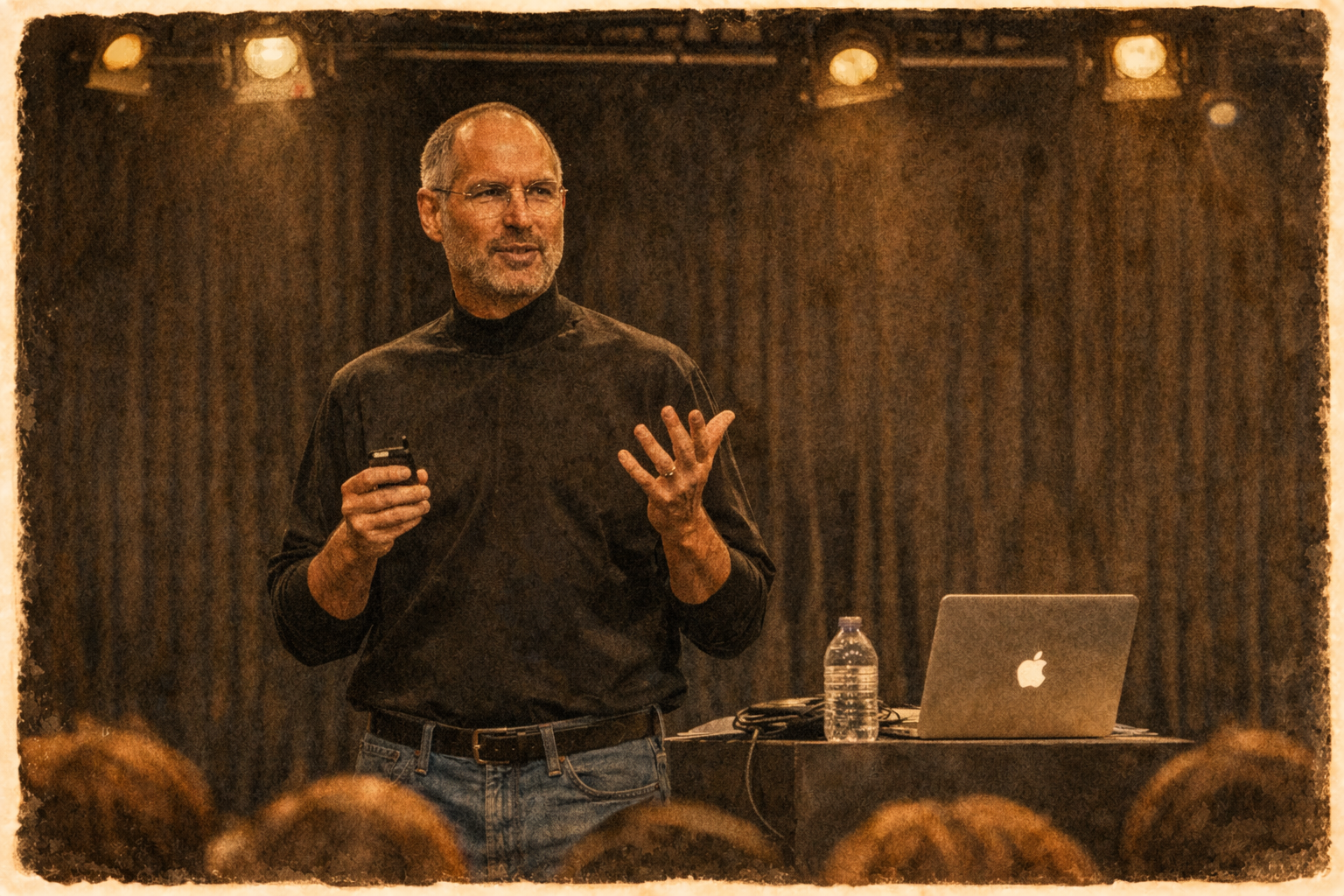
Steve Jobs
TECHNOLOGY VISIONARY AND ENTREPRENEUR
The co-founder of Apple, Pixar, and NeXT, who transformed personal computing, animated filmmaking, mobile phones, and digital music in a single career. Adopted as an infant and a college dropout, Jobs built Apple in his parents' garage at 21, was fired from his own company at 30, and returned a decade later to lead what became the most valuable company in the world. He brought an obsessive eye for design, a calligrapher's feel for beauty, and a stubborn belief that the people who are crazy enough to think they can change the world are the ones who do.