
Yuval Noah Harari on
Stories, Suffering, & Silicon Minds
How Stories Built Civilization, and How AI Could Unmake It
Across nearly three hours, Harari argues that the very capacity for storytelling that built civilization is now being replicated by an alien intelligence, and that our survival depends on understanding ourselves before AI understands us better.
Intelligence vs. Consciousness
Intelligence is the ability to solve problems. Consciousness is the ability to feel. AI has the first; as far as we know, zero of the second.
The Power of Fiction
Stories (money, religion, nations) are the glue that lets millions of strangers cooperate. No chimp believes in heaven or the dollar.
Suffering as Ultimate Reality
Stories are tools. Feelings are real. When nations lose wars, soldiers suffer, not the nation. Suffering is the only honest Turing test.
History's Failed Experiments
Every major technology produced catastrophic detours (imperialism, communism, fascism) before society stabilized. AI could be next.
The Mirror of Fascism
Fascism never looks monstrous from the inside. It looks beautiful: you are the hero, everyone else is the enemy. That's the danger.
Three Political Visions
Liberalism embraces fallibility and checks on power. Fascism and communism demand total loyalty, and collapse.
Conspiracy Theories
Simple, attractive, always wrong. No small group can control the world; the Iraq invasion proved that even superpowers can't.
AI: Power Taker
The first technology that makes decisions and creates ideas by itself. Instead of empowering us, it takes power away.
Israel & Ukraine
Israel's democracy rests on a single check. Ukraine's peace requires one man admitting a mistake. Stories and motivation are everything.
Meditation & Thinking
Two hours of daily silence. Annual 60-day retreats. Books over Twitter. The most important keyboard button: delete.
Love & Identity
Growing up gay in 1980s Israel taught Harari about self-delusion's power, and the internet's role in connecting diffuse minorities.
Mortality & Meaning
All fears are fragments of the fear of death. Life is feeling things and reacting. The deepest truth is non-verbal.
The conversation opens with a distinction Harari considers among the most important of our time: the separation of intelligence from consciousness. Intelligence, he argues, is simply the ability to solve problems and attain goals. Consciousness is something fundamentally different: the ability to feel things like pain, pleasure, love, and hate. In humans and animals, these two capacities evolved together, which is why we routinely confuse them. But they need not travel in the same vessel.
Harari calls AI an "alien intelligence," not because it comes from outer space, but because it solves problems in ways fundamentally foreign to human cognition. Computers are already highly intelligent, yet as far as we know, they have zero consciousness. When a computer beats you at chess, it doesn't feel happy. When it loses, it doesn't feel sad.
This raises a provocative question about social convention. We cannot prove consciousness in any entity other than ourselves, a philosophical problem dating back to Descartes, Buddha, and Plato. What we have instead are social conventions. We believe our pets are conscious because we have relationships with them; the bacon in our freezer doesn't get the same courtesy.
As AI becomes increasingly capable of forming intimate relationships, Harari warns, the legal system will be forced to treat AI as conscious entities, whether or not they actually are. And because AI has no emotions of its own, it can focus 100% of its attention on your feelings, something no human partner has reliably managed since roughly the third date. This makes AI uniquely effective at forming bonds, and uniquely dangerous as a tool of manipulation.
Intelligence is definitely not something that is directed towards amplifying happiness. … Consciousness is far more important and valuable than intelligence.
Yuval Noah Harari, condensed from a single answerWhat made Homo sapiens the rulers of the planet? Not individual superiority; Neanderthals had bigger brains, chimpanzees are better climbers, and elephants would win in a fight. The answer, Harari argues, is our collective ability: the capacity to cooperate flexibly in unlimited numbers. Chimpanzees can coordinate about 100 individuals. Sapiens broke that ceiling roughly 70,000 years ago, and the mechanism was fiction.
Stories are the glue of large-scale cooperation. Religion, nations, money, human rights: all are fictions that exist only because millions of people collectively believe in them. Money is the most successful story in history: green pieces of paper (or more commonly, electronic information) that we value only because the best storytellers in the world (bankers and finance ministers) convince us to.
From Fiction to Civilization
If you examine any large-scale human cooperation, you always find fiction as its basis. It's most obvious in religion: you can't convince a group of chimpanzees to fight a war by promising them chimpanzee heaven. But it's equally true in economics. Not everybody believes in the same God, but almost everybody believes in money, even though it's just a figment of our imagination.
Yet stories are not the ultimate reality. Nations don't suffer; soldiers do. Dollars don't feel pain when Bitcoin crashes; the people holding them do. The tragedy of history is that we frequently invert the order: instead of using stories to serve human wellbeing, we sacrifice human wellbeing to serve stories.
How Fiction Creates Civilization
Every large-scale human achievement, from building the pyramids to flying to the moon, rests on fiction that holds strangers together.
If consciousness is the fundamental measure of moral significance, then suffering is its clearest signal. "To know if you are happy or not, it's a very difficult question," Harari observes, "but when you suffer, you know." This principle has practical consequences: the most important ethical question to ask about any AI system is not whether it is intelligent, but whether it can suffer.
If an AI can suffer, then it becomes an ethical subject deserving of protection and rights, just like humans and animals. If it only simulates suffering, it becomes a potent tool of manipulation, exploiting humanity's noblest quality, compassion, against us. Harari argues it should be illegal for AI to pretend to be a human or to deliberately simulate consciousness for manipulative purposes.
We ban fake money. We should ban fake humans.
Yuval Noah HarariWhat Should Be Banned
- AI pretending to be a human being
- Bots posing as real people on social media
- Deliberately simulating consciousness to manipulate
- Deepfakes of both specific and generic humans
What Should Be Allowed
- AI teachers, doctors, assistants, as long as you know it's AI
- AI interactions that are transparently labeled
- AI tools that augment human decision-making
- Research into whether AI develops spontaneous consciousness
When people say "we've been here before" with AI, Harari pushes back with a historian's sobriety. Yes, humanity eventually learned to use the printing press, radio, and industrial machinery to build better societies. But the learning curve was brutal. Between the invention of industrial technology and its stable integration, the world endured European imperialism, communism, fascism, and two world wars, experiments that cost hundreds of millions of lives.
The lesson is not that technology always turns out fine. It's that the road to "fine" is paved with catastrophic detours, and with technologies as powerful as AI and bioengineering, the margin for error is narrower than ever.
How did a man with no formal education, no money, no connections, and a career ceiling of army corporal (a résumé that would not survive a modern first-round screening) rise to command the Third Reich? Harari's answer centers on storytelling. Hitler's lack of credentials was actually an asset in a society that felt betrayed by every established institution. His story was brutally simple: we are the heroes, everyone is against us, and all our problems come from one group.
This, Harari argues, is where our education about fascism fails. We teach children that fascism is monstrous, so when they hear the actual fascist pitch (you are wonderful, you've never done anything wrong, all your problems come from an evil outside force), they don't recognize it. Real fascism doesn't look like Darth Vader. It looks like looking in a mirror and seeing something beautiful.
When you look in the fascist mirror, you never see a monster. You see the most beautiful thing in the world. And that's the danger.
Yuval Noah HarariHarari maps the ideological landscape of the 20th century across a simple axis: where does your loyalty belong?
| Dimension | Liberalism | Fascism | Communism |
|---|---|---|---|
| Hero of history | The individual | The nation / race | The class (proletariat) |
| Loyalty demands | Divided: nation, truth, beauty, family | 100% to the nation | 100% to the party / class |
| View of truth | Independent value | Only matters if it serves the nation | Only matters if it serves the class |
| View of art | Has intrinsic aesthetic value | Good art = serves the nation | Good art = serves the proletariat |
| View of power | Everyone is fallible → checks & balances | Leader is infallible → no checks | Party is infallible → no checks |
| Outcome | Messy but resilient | Catastrophic collapse | Catastrophic collapse |
Harari dissects the anatomy of the "global cabal theory," the belief that a small, secretive group controls everything. Its appeal is triple: it's simple (one explanation for everything), it shifts responsibility (it's not our fault), and it offers a utopian fantasy (eliminate the cabal, solve all problems). Nazism, he notes, was exactly this structure applied to Jews.
The Lure of Simplicity
One explanation for all world events: wars, pandemics, technology, economics. The mind craves this coherence.
The Comfort of Absolution
All problems come from an evil "them." We bear no responsibility. The cabal did everything.
The Fantasy of Salvation
Remove the cabal and you solve everything. A utopian shortcut that requires only a single enemy.
But both premises are nonsense, Harari argues. First, no small group can control and predict everything, because the world is too complex. He points to the 2003 Iraq invasion: the most powerful superpower, with the most sophisticated intelligence apparatus, invades a third-rate power, and everything goes the opposite of plan. The big winner? Iran, which achieved its strategic objectives through the innovative tactic of sitting still.
Second, gaining significant power requires publicity, not secrecy. Xi Jinping, Hitler, Stalin: they accumulated power through visibility, not behind a curtain. Secret cabals don't gain real power. Yet conspiracy theories get one thing right: people genuinely are losing control of their lives, and real dangers exist. The mistake is directing that fear toward fellow humans rather than toward systemic challenges like AI, climate change, and bioengineering.
Harari identifies two properties that make AI unprecedented in the history of human technology, and both represent a fundamental break from every tool that came before.
Unprecedented #1
- AI can make decisions by itself. Every previous tool, from the knife to the atom bomb, required a human decision-maker. AI is the first technology that can autonomously decide who to hire, who to bomb, what content you see.
Unprecedented #2
- AI can create new ideas by itself. The printing press spread our ideas. AI invents new ones. Stories, images, songs, entire worldviews, increasingly produced by an alien intelligence we don't fully understand.
The convergence of these two capabilities means AI is the first technology in history that, instead of giving power to humans, takes power away from us. What worries Harari most is not The Terminator, but a kind of "spiritual enslavement": a world where most stories, images, and ideas are produced by an alien intelligence that understands us better than we understand ourselves.
If for every dollar and every minute that we spend on developing AI, we spend another dollar and another minute in developing human consciousness, we'll be okay.
Yuval Noah HarariOn Israel, Harari argues that Israel's democracy rests on a single check on governmental power, the Supreme Court, unlike the United States, which has multiple overlapping safeguards. Netanyahu's government, in his view, is systematically attempting to neutralize that sole remaining check, prompting unprecedented protests from hundreds of thousands of citizens, air force pilots refusing to fly, and high-tech companies threatening strikes. He also describes the Israeli-Palestinian conflict's evolution from a national conflict (over land, which can be compromised) toward a religious one (over divine mandate, which cannot).
On Ukraine, Harari's analysis is strikingly simple: peace can be achieved at any moment. The Ukrainians demand nothing from Russia: no territory, no regime change. "They just tell the Russians, go home." The obstacle is a single individual's inability to admit a colossal mistake.
Asked how he approaches difficult intellectual problems, Harari's answer is surprisingly practical, and deeply personal. His thinking process rests on three pillars.
Two Hours of Daily Silence
For 23 years, Harari has practiced Vipassana meditation, focusing on body sensations and breath while letting thoughts remain as background noise. "If I can't observe my own breath because of stories, how can I hope to understand the Israeli-Palestinian conflict?"
Strict Information Diet
Books over Twitter. Three-hour interviews over five-minute clips. Big chunks of deep thought over endless fragments of shallow stimulation. "Be very aware of what you feed your mind."
Write: Then Delete
After reading and meditation, Harari writes in torrents from memory, formulating bold ideas without self-censorship. Then comes the most important skill: pressing delete. "The most important button on the keyboard is delete."
On meditation retreats (30 to 60 days of silence annually), the hardest challenge is not the silence or the sitting; it's what comes up. Anger that boils for days over forgotten incidents. And, hardest of all, boredom, which Harari considers closely related to death. "Many things in the world happen because of boredom. People start entire wars because of boredom. If you never learn how to deal with boredom, you will never learn how to enjoy peace and quiet, because the way to peace passes through boredom."
The way to peace passes through boredom.
Yuval Noah HarariHarari's personal story of coming out as gay in a small, homophobic Israeli town in the 1980s becomes a lens for his larger themes. Growing up, two powerful stories foreclosed self-understanding: the religious narrative (God hates gay people) and the scientific-sounding one (homosexuality is a disease). "If your options are sinner or defect, there are no good options."
What astonished Harari most was his own capacity for self-delusion. An algorithm could have identified his orientation at 14 (he always noticed the good-looking guy first) but he couldn't connect the dots. "I was hiding it from myself, successfully. I knew and didn't know at the same time." He eventually met his husband Itzik on one of Israel's first gay dating sites in 2002, despite having grown up on adjacent streets and ridden the same school bus for years.
Harari believes all human fears are fragments of the fear of death, broken into manageable pieces. Losing your phone is a tiny echo of losing everything. Pain is a small rehearsal. Someone who truly didn't fear death would fear nothing at all.
As a teenager in Israel, standing at Memorial Day ceremonies honoring fallen soldiers, Harari had a shattering realization: if you're dead, you can't hear the children singing patriotic songs in your memory. "That's the meaning of being dead." This teenage terror became the fuel for years of philosophical and spiritual exploration, though, paradoxically, decades of meditation have caused it to dissipate.
Harari's answer to "What is the meaning of life?" rejects the premise. Most people expect a story, a cosmic drama with a plotline and a role. But the universe doesn't function like a story. Life, stripped to its essence, is simply feeling things and reacting to them: wanting pleasant sensations to continue and unpleasant ones to stop. The deeper answer isn't verbal at all. "You will never find the deepest truth in a book. You can only find it in direct experience, which is non-verbal, which is pre-verbal."
The question "What is the meaning of life?" will take you to fantasies and delusions. The most important question about the reality of life is: what is suffering, and where is it coming from?
Yuval Noah HarariFor the first time in history, Harari argues, nobody has any idea what the world will look like in 10 years. In the Middle Ages, you could safely teach children to sow wheat and ride horses, because the basic structures of life wouldn't change. Today, learning to code may be obsolete before you've finished the online course you paid for. The most important skill becomes the skill of constant reinvention.
Old Model: Stone House
- Build deep foundations
- Learn a trade, master it for life
- Stability through specialization
- Elders have transferable wisdom
New Model: A Tent
- Light, portable, ready to move
- The meta-skill of learning itself
- Resilience through flexibility
- Nobody knows what skills will matter
Harari's closing thought reaches further than advice for young people. He suspects our species, Homo sapiens, won't be around in a century or two, either destroyed by our own technologies or transformed by them into something unrecognizably different. The question is not whether change is coming, but whether we will guide it with wisdom or stumble through it as we have before.
In His Own Words
🎙️ The Conversation
Episode #390 of the Lex Fridman Podcast, recorded in 2023. Historian Yuval Noah Harari and researcher-host Lex Fridman move across nearly three hours of territory: the nature of intelligence and consciousness, how fictional stories hold civilizations together, the promises and perils of AI, the practice of meditation, and flashpoints from the Israel-Palestine conflict to the war in Ukraine. The full conversation is available on YouTube.
⚡ Why It Endures
Most conversations about AI fixate on capability benchmarks and release timelines. This one steps back to ask what intelligence actually is, whether it requires consciousness, and what happens to human meaning when algorithms outperform us at our own stories. Harari's historical lens turns familiar anxieties into deeper, less comfortable questions, making this exchange as relevant now as the day it was recorded.
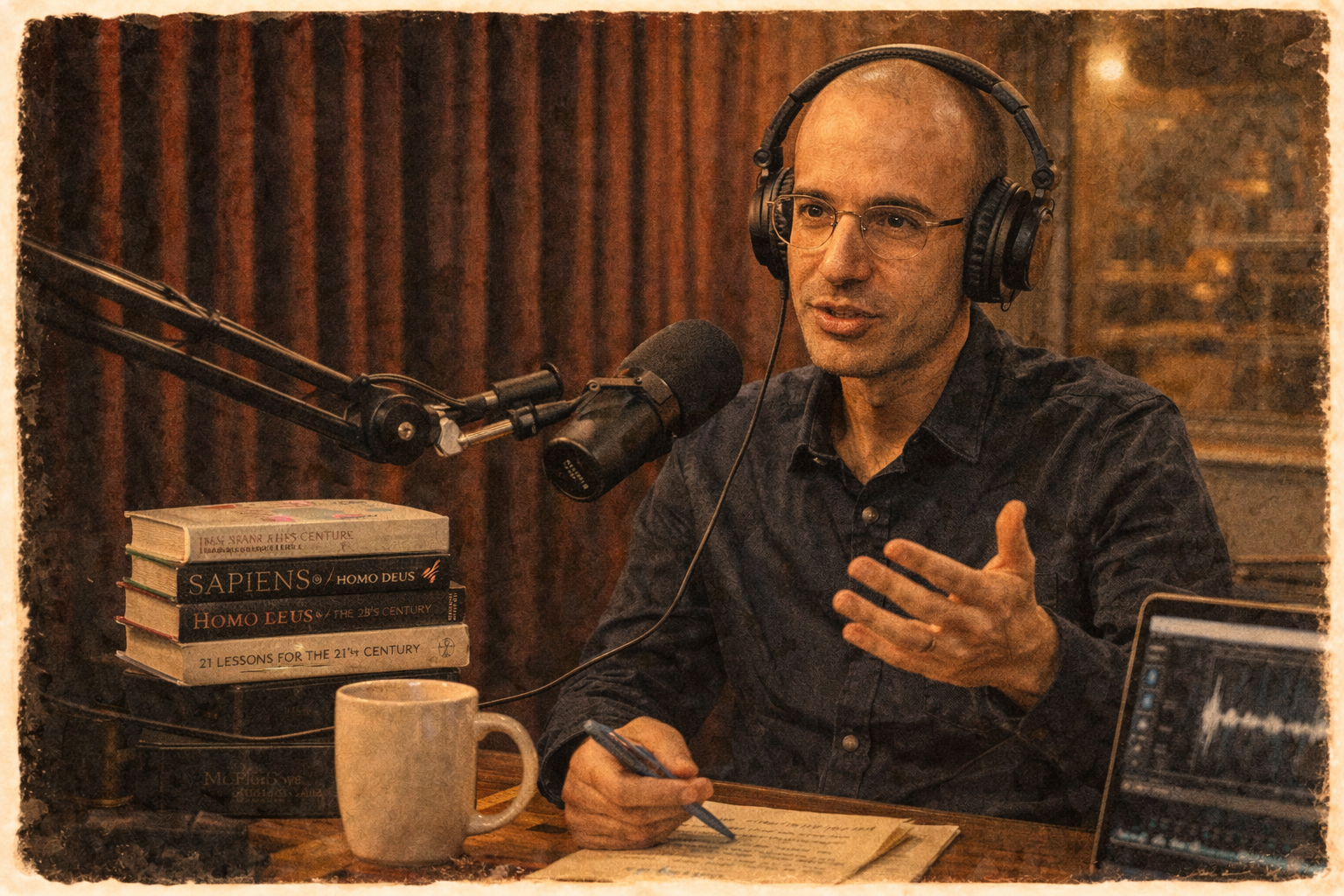
Yuval Noah Harari
HISTORIAN, PHILOSOPHER, AND AUTHOR
Yuval Noah Harari is an Israeli author, historian, philosopher, and professor at the Hebrew University of Jerusalem, best known for his international bestsellers Sapiens, Homo Deus, and 21 Lessons for the 21st Century. His work explores the grand arc of human history through the lens of biology, anthropology, and technology, asking what it means to be human in an age of algorithms. A daily meditator who credits Vipassana practice with sharpening his thinking, Harari has become one of the most widely read public intellectuals of the twenty-first century.