
Randy Pausch’s Last Lecture on Really Achieving Your Childhood Dreams
Randy Pausch's Last Lecture on
Really Achieving Your Childhood Dreams
Three Acts That Build to Two Hidden Revelations
persistence made them real
making dream-chasing scalable
distilled from a full life
Randy structures the lecture as a journey from personal dreams to universal wisdom. But the true meaning is hidden: the talk isn't about achieving dreams at all. It's about how to lead your life. And the audience in the room isn't the real audience. His children are.
On September 18, 2007, Randy Pausch, a 46-year-old computer science professor at Carnegie Mellon, stood before a packed McConomy Auditorium and delivered a lecture he knew would be among his last. Diagnosed with terminal pancreatic cancer and given just 3 to 6 months to live, he chose not to talk about dying. He chose to talk about living.
The lecture was part of a university series called "Journeys," though it had previously been named "The Last Lecture," a format asking professors what they'd say if it were their final talk. For Randy, that premise was no longer hypothetical. He opened with push-ups to prove he was in better shape than most of the audience, then spent 76 minutes weaving together humor, stories, and a lifetime of accumulated wisdom.
The Elephant in the Room
Randy addressed his diagnosis head-on in the opening minutes, showing his CT scans and then immediately pivoting. He set three ground rules for himself: no talking about cancer, no talking about things more important than childhood dreams (his wife and kids), and no spirituality or religion, though he joked about a "deathbed conversion" to buying a Macintosh.
Instead, the lecture would cover his childhood dreams, how he'd achieved them, how he'd helped others achieve theirs, and the lessons he'd learned along the way.
In his liver at time of lecture
Diagnosed one month before this lecture
Dylan, Logan & Chloe
We cannot change the cards we are dealt, just how we play the hand.
Randy Pausch, Opening MinutesBorn in 1960, Randy grew up watching men land on the moon. Anything felt possible. He kept a list of specific childhood dreams: not vague aspirations, but concrete goals. He then spent the first act of his lecture showing how he pursued each one, revealing that the lessons came not from succeeding but from the journey itself.
Experience Zero Gravity
Not dreaming of being an astronaut, just the floating. He found a NASA program, got rejected as faculty, then finagled his way aboard as a "web journalist." He brought VR headsets for everyone as his ticket in.
AchievedPlay in the NFL
He never made it. He was the smallest kid on the team at age nine. But Coach Jim Graham taught him fundamentals and a lesson he carried for life: criticism means people still care about you.
Deeper LessonAuthor in World Book Encyclopedia
After becoming an authority on virtual reality, the World Book came calling. He wrote the entry under "V for Virtual Reality." His childhood shelf copy came full circle.
AchievedBe Captain Kirk
He couldn't captain the Enterprise, but he met William Shatner, built him a VR Star Trek bridge, and realized the real dream was leadership: Kirk wasn't the smartest on the ship, but he ran it.
ReimaginedWin Giant Stuffed Animals
At theme parks, Randy became a midway-game master. He proved it by having the giant bears brought on stage. For the cynics, he said: "I can show them the bears!"
AchievedBe a Disney Imagineer
Rejected at first ("the nicest go-to-hell letters I've ever gotten"), he eventually negotiated a sabbatical at Imagineering and worked on the Aladdin VR ride. He called it a once-in-five-careers experience.
AchievedWoven throughout all six dream stories is one recurring metaphor: the brick wall. Every dream involved obstacles: NASA rejecting faculty, Disney sending rejection letters, deans blocking sabbaticals. Randy's reframe was powerful: the walls aren't there to keep you out. They're there to give you a chance to show how badly you want something. And they're there to stop the people who don't want it badly enough.
What Walls Look Like
- NASA policy: no faculty on the Vomit Comet
- Disney's rejection letter: "no positions for your qualifications"
- Dean Wormer blocking the Imagineering sabbatical
- Carnegie Mellon declining his graduate school application
How Randy Got Through
- Reinvented himself as a "web journalist" for NASA
- Spent 80 hours talking with VR experts worldwide to prepare, then landed a lunch with Jon Snoddy
- Went over the Dean's head to Gene Block's office
- Mentor Andy Van Dam called in favors with Nico Habermann
Randy discovered something unexpected: helping others chase their dreams was even more fulfilling than achieving his own. This act of the lecture covers how he turned from dream-chaser into dream-enabler through teaching, institution-building, and software that could scale to millions.
Building Virtual Worlds
A revolutionary course at Carnegie Mellon: 50 students from all departments, randomly assigned into four-person teams, building five VR projects per semester. The final showcase filled McConomy Auditorium with standing-room crowds. President Jerry Cohen described the energy as "an Ohio State football pep rally, except for academics." Randy's secret: shuffle the teams every two weeks and tell students "you make whatever you want."
The Entertainment Technology Center
Co-founded with Don Marinelli, the ETC was a two-year master's program putting artists and technologists in small teams to make things. No deans to report to, explicit license to break the mold, and field trips to Pixar and Industrial Light & Magic. Companies wrote promises to hire graduates before they were even admitted. The ETC went global (Singapore, Australia, Korea), becoming, as Randy described it, something like Cirque du Soleil for academia.
Alice: The Ultimate Head Fake
A programming language that teaches coding through making movies and games. Kids think they're writing movie scripts; they're actually learning Java. Downloaded over a million times and used by 10% of U.S. colleges. Randy called it his Moses moment: he could see the promised land but wouldn't get to set foot in it. The next version would use characters from The Sims, the bestselling PC game in history.
The final act steps back from specific stories to distill the wisdom Randy accumulated from parents, mentors, colleagues, and students. These aren't abstract platitudes; each one is anchored in a concrete story from his life.
Fundamentals, Fundamentals, Fundamentals
Coach Jim Graham showed up to practice without footballs. Why? Twenty-two players on the field and only one touches the ball at a time. Master the fundamentals, the basics that make the fancy stuff possible.
Your Critics Are Your Best Friends
After Graham rode him hard at practice, an assistant coach told Randy: "When you're screwing up and nobody's saying anything anymore, that means they gave up." Criticism = caring.
Wait Long Enough
From Jon Snoddy at Disney Imagineering: "When you're angry at somebody, just wait. People will show you their good side. Just keep waiting, no matter how long it takes."
Never Give Up
Wait-listed at Brown. Rejected by Carnegie Mellon. He persisted through every closed door. He eventually called Brown every day until they admitted him just to stop the calls.
Be Earnest, Not Hip
Tell the truth. Be real. "I'll take an earnest person over a hip person every day, because hip is short term. Earnest is long term."
Show Gratitude
When he got tenure, he took his entire research team to Disney World. His reason: "These people just busted their ass and got me the best job in the world for life. How could I not do that?"
Have Fun: It's Mandatory
President Cohen told him: "Please tell them about having fun, because that's what I remember you for." Randy said that's like a fish talking about the importance of water.
Luck = Preparation + Opportunity
The NASA trick, the Disney sabbatical, the Tom Furness lunch: every "lucky break" came because Randy had spent years preparing for the moment.
In football, a head fake is when you look one way but go another. Randy's entire lecture was built on two of them, with the true meaning hidden beneath the surface. He revealed them only in the final moments.
Head Fake #1
- It's not about achieving your dreams. The lecture appears to be about childhood dreams and how to accomplish them. But Randy reveals in the final minutes: it's really about how to lead your life. If you lead it the right way, the karma will take care of itself. The dreams will come to you.
Head Fake #2
- The talk isn't for you. The audience thought the lecture was for them. It wasn't. It was for his three young children (Dylan, Logan, and Chloe) who were too small to remember their father. This was his message in a bottle.
Randy emphasized repeatedly: you can't get anywhere alone. People have to help you, and they help you by telling the truth. He populated his lecture with the mentors, colleagues, friends, and family who shaped his path.
Coach Jim Graham
Youth Football Coach · Taught fundamentals without a football, and the life lesson that criticism means people care about you enough to keep trying.
Andy Van Dam
Mentor at Brown · Steered Randy toward a Ph.D., called out his arrogance with love, and brokered his admission to Carnegie Mellon when all seemed lost.
Jon Snoddy
Disney Imagineer · Taught that waiting for someone's best side always pays off, and showed that the secrets business and the sharing business can coexist.
Don Marinelli
ETC Co-Founder · The yin to Randy's yang. They shared an office for six years "like sharing with a tornado." Don got the lion's share of the ETC credit, and deserved it.
Jai Pausch
Randy's Wife · The reason Randy shifted focus. On stage, he surprised her with a birthday cake and led the audience in singing "Happy Birthday," because even during what might be his final lecture, he felt she deserved the spotlight more.
His Parents
The Foundation · Let him paint equations on his bedroom walls. Funded a dormitory in Thailand so about 30 students could attend school each year. His dad kept a Bronze Star from WWII secret for 50 years of marriage.
In His Own Words
🎓 The Lecture
This talk was delivered on September 18, 2007, in McConomy Auditorium at Carnegie Mellon University as part of a series called "Journeys," previously known as "The Last Lecture," a format asking professors what wisdom they'd impart if it were their final talk. For Randy Pausch, a 46-year-old computer science professor diagnosed with terminal pancreatic cancer one month earlier, the premise was no longer hypothetical. Before a standing-room-only audience of colleagues, students, friends, and family, he delivered 76 unscripted minutes that reframed mortality as an invitation to distill what matters most.
⚡ Why It Endures
Randy passed away on July 25, 2008, ten months after the lecture. His children Dylan, Logan, and Chloe were 6, 3, and 2. The talk has since been viewed over 20 million times online and spawned a New York Times bestselling book translated into dozens of languages. Its durability lies in the architecture: what appears to be a feel-good talk about childhood dreams is actually a meticulously structured argument for living with integrity, gratitude, and joy, and a father's permanent record of everything he wanted his children to know about who he was and what he believed.
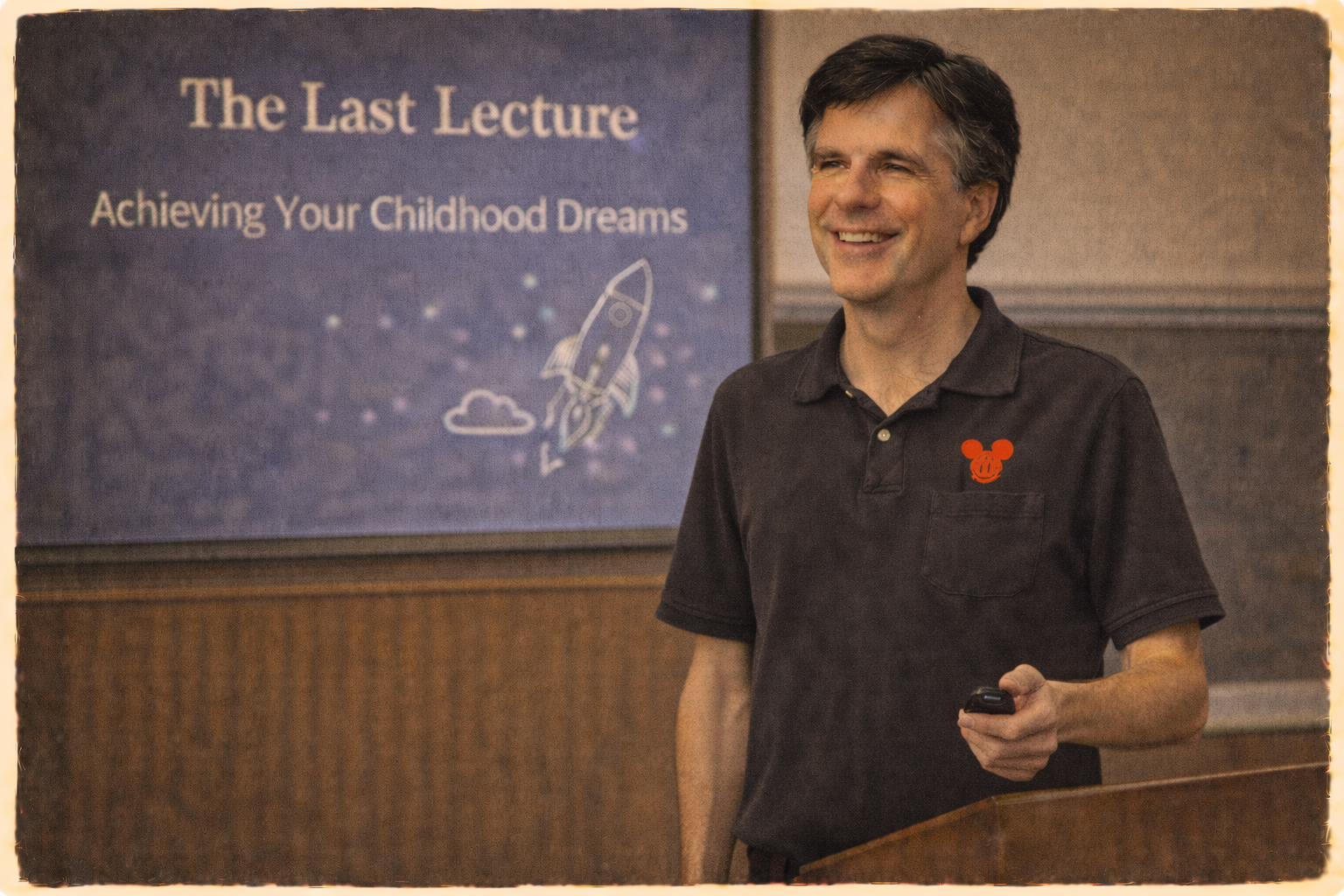
Randy Pausch
COMPUTER SCIENTIST AND EDUCATOR
A pioneering professor at Carnegie Mellon University, known for co-founding the Entertainment Technology Center, creating the Alice programming environment that taught millions of students to code through storytelling, and delivering one of the most-watched lectures in academic history. Pausch brought childlike wonder, relentless optimism, and radical generosity to everything from virtual reality research to mentoring students to the question of how to live when you know time is running out.