
Claude Shannon on Creative Thinking
Claude Shannon on
Creative Thinking
Three Pillars That Make an Einstein:
Training, Intelligence & Motivation
& thousands of solved problems
to do rigorous work
makes all the difference
Shannon argues that all three pillars are necessary for creative work, but motivation is the ingredient that separates the competent from the extraordinary. Training is environment, intelligence is heredity, but motivation is the fire that won't let you stop at five o'clock.
The Critical Mass of Ideas
Borrowing from Turing, Shannon compares the mind to uranium: some people absorb ideas, others amplify them exponentially. A few "super-critical" thinkers produce the vast majority of breakthroughs.
Training & Experience
You can't expect a lawyer to produce a new theory of physics. Deep domain knowledge fills your mental matrix with solved problems to draw analogies from.
Intelligence as Baseline
Shannon is candid: good research requires above-average cognitive ability. This is largely hereditary: necessary, but not sufficient on its own.
Motivation as the Differentiator
The secret ingredient. Curiosity, constructive dissatisfaction, and the joy of elegant solutions combine into a drive so powerful you don't care what time it is.
Simplification
Strip every problem to its bare essentials. Even if the simplified version barely resembles the original, solving it often reveals the path back to the full solution.
Analogy & Similar Problems
Two small jumps beat one impossible leap. Find a similar solved problem, map the analogy, and translate the known solution to your unknown.
Restating the Problem
Change the words, the viewpoint, the angle. Mental ruts are the enemy, which is why a newcomer sometimes solves in seconds what experts missed for months.
Generalization
The moment you solve something specific, ask: can I make this broader? If it works in 2D, does it work in N dimensions? This is immensely powerful.
Structural Analysis
If the gap is too wide, break it into smaller steps. Wander, backtrack, arrive by a roundabout route, then simplify the path once you can see it clearly.
Inversion
If you can't get from P to S, try working backward from S to P. Shannon used this trick to simplify a nim-playing machine from complex to trivial via feedback.
Shannon opens with a striking analogy borrowed from Alan Turing: the human brain works like uranium in a nuclear reaction. For some people, you shoot one idea in and get half an idea out, and the reaction fizzles. But for others, those beyond what Shannon calls "the knee of the curve", one idea triggers two, then four, then an exponential cascade. A tiny fraction of the population produces the overwhelming majority of important ideas.
Sub-Critical Mind
- One idea goes in, half an idea comes out
- The chain reaction fizzles and dies
- Ideas are absorbed, not amplified
- Below the "knee of the curve"
Super-Critical Mind
- One idea goes in, two or more come out
- Chain reaction accelerates explosively
- Ideas breed more ideas exponentially
- Well beyond the "knee of the curve"
Newton at Twenty-Five
Shannon's case study for the super-critical mind: Isaac Newton, who by the age of 25 had produced enough foundational science to make ten or twenty researchers famous. His output in that short span included the binomial theorem, differential and integral calculus, the laws of gravitation, the laws of motion, and the decomposition of white light.
Shannon's point is not that Newton was merely intelligent. Plenty of people are intelligent. It's that Newton was operating above the critical threshold where every idea sparked multiple new ones, creating an unstoppable cascade of discovery.
Revolutionized
of Ideas
There are some people if you shoot one idea into the brain, you will get a half an idea out. There are other people who are beyond this point at which they produce two ideas for each idea sent in.
Shannon, paraphrasing Alan Turing's analogyShannon identifies three non-negotiable requirements for scientific research, invention, or any creative intellectual work. None alone is sufficient. Missing any one of them, and the enterprise fails, no matter how strong the other two might be.
Pillar I: Training & Experience
Deep knowledge of your field is the starting line. You need thousands of solved problems in your mental library (what Shannon calls "P-primes and S-primes") to draw analogies from. Without this foundation, brilliance has nothing to work with.
Pillar II: Intelligence & Talent
A baseline level of raw cognitive ability is non-negotiable. Shannon is blunt about this: research requires an IQ well above average. He frames this as largely hereditary, something you either have or you don't.
Pillar III: Motivation & Drive
The factor that separates an Einstein from everyone else. A relentless, almost obsessive need to find the answer, so strong a drive that you don't notice whether it's five o'clock or midnight. Without this, training and intelligence sit idle.
The research man should probably have an extremely strong drive to want to find out the answers, so strong a drive that he doesn't care whether it is five o'clock, he is willing to work all night to find out the answers and all weekend if necessary.
Claude ShannonShannon dissects the third pillar, motivation, into three distinct psychological traits. He acknowledges that these are shaped by temperament and early experience, but insists they are the observable signatures of the creative drive. As he puts it, paraphrasing Fats Waller on swing music: "either you got it or you ain't."
Curiosity
An insatiable hunger to know how things work. Not studying because you're told to, but because you simply cannot stop wondering what the answer is. Shannon says a good scientist "wants to know the answers to questions; and if he sees things, he wants to raise questions."
Constructive Dissatisfaction
Not a pessimistic view of the world, but a productive irritation. The persistent feeling that "this is OK, but I think things could be done better. I think there is a neater way to do this." A continual slight itch when something doesn't look quite right.
Joy in Elegant Solutions
The visceral thrill of seeing a clever result. Shannon describes getting a "big bang" from proving a theorem he's wrestled with for a week, and a "big kick" from seeing an engineering design that achieves great results with very little equipment.
The heart of the lecture. Shannon catalogues mental "tricks" that he believes can be consciously applied to accelerate problem-solving. He argues that great researchers use these techniques instinctively, but that anyone can benefit from applying them deliberately. If you're stuck, try working through this list. The answer may be closer than you think.
Simplification
Strip the problem down to its absolute essentials. Remove every piece of extraneous data until you can see the core challenge clearly. Even if the simplified version barely resembles the original, solving it first often reveals a path back. As Shannon puts it: almost every problem is "befuddled with all kinds of extraneous data," and cutting through that is one of the most powerful approaches available.
Seeking Analogous Problems
If you can't jump straight from Problem (P) to Solution (S), find a similar problem (P') that's already been solved (S'). Map the analogy from P' to P, then from S' to S. Shannon emphasizes that this is why experience matters so much. An experienced researcher has "thousands of problems that have been solved" in their mental matrix, making it far easier to find a useful P'. Two small jumps are always easier than one impossible leap.
Restating the Problem
Change the words. Change the viewpoint. Look at it from every possible angle, then try to see several angles simultaneously. Mental ruts are the enemy. You go around in circles, unable to break free from certain ways of looking at a problem. This is why someone "quite green to a problem" will sometimes walk in and find the solution instantly, while you've been laboring over it for months.
Generalization
The moment you solve something specific, ask: can I make this broader? If the result works in two dimensions, does it extend to N? If it applies to a specific algebra, does it hold in a general algebraic field? Shannon calls this "actually quite easy to do if you only remember to do it." The same principle applies in engineering: when you see a clever technique, ask whether it can solve a larger class of problems.
Structural Analysis
If the gap between problem and solution is too wide, break the journey into a chain of smaller, provable steps. You may wander and backtrack. Many mathematical proofs have been found by "extremely roundabout processes", but once you arrive at the solution, you can often simplify the path. The same applies to design: build something clumsy first, then start cutting out the parts that were never needed.
Inversion
Stuck going from P to S? Turn it around, assume S is given and try to derive P. Shannon discovered this technique while designing a machine that played the game of nim: the forward direction was painfully complex, but inverted, the problem became simple. The solution was a feedback loop: start with the desired result and run it backward until it matches the input. Often, finding the path in one direction makes it trivial to invert in small batches.
A practical guide for choosing which of Shannon's six techniques to try first, based on the nature of the block you're facing.
In Shannon's Own Words
⚛️ Ideas Have Critical Mass
A small fraction of people generate the vast majority of important ideas. The "super-critical" mind doesn't just absorb, it amplifies. Training, talent, and drive together push you past the threshold where ideas start breeding more ideas.
🔥 Motivation Beats IQ
Intelligence and training are necessary but not enough. Relentless curiosity and constructive dissatisfaction, the feeling that things could always be done a little better, are what separate the competent from the extraordinary.
🛠️ Creativity Has Techniques
Great thinkers use repeatable mental tools: simplification, analogy, restatement, generalization, structural analysis, and inversion. Shannon's core message: these can be learned and deliberately applied by anyone willing to try.
👁️ Fresh Eyes Win
Mental ruts are the silent killer of creative work. Someone brand new to a problem can sometimes solve it immediately, while the expert has been going in circles for months. Always seek new angles, and be wary of the comfort of familiar perspectives.
🎙️ The Lecture
This talk was delivered on March 20, 1952, at the Murray Hill, New Jersey offices of Bell Telephone Laboratories as part of an internal seminar series. Shannon was 35 years old and already famous for his 1948 paper A Mathematical Theory of Communication, which single-handedly founded information theory. In this rare lecture to fellow researchers, he turned his analytical mind inward, examining not what to think, but how to think creatively.
⚡ Why It Endures
For decades this transcript circulated only among engineers and mathematicians. Yet Shannon's insights (that creativity is a learnable skill, that motivation matters more than raw IQ, that mental ruts are the silent enemy of breakthroughs) feel as fresh and actionable today as they did in 1952. The six techniques he catalogued remain a practical toolkit for anyone facing a hard problem, in any field.
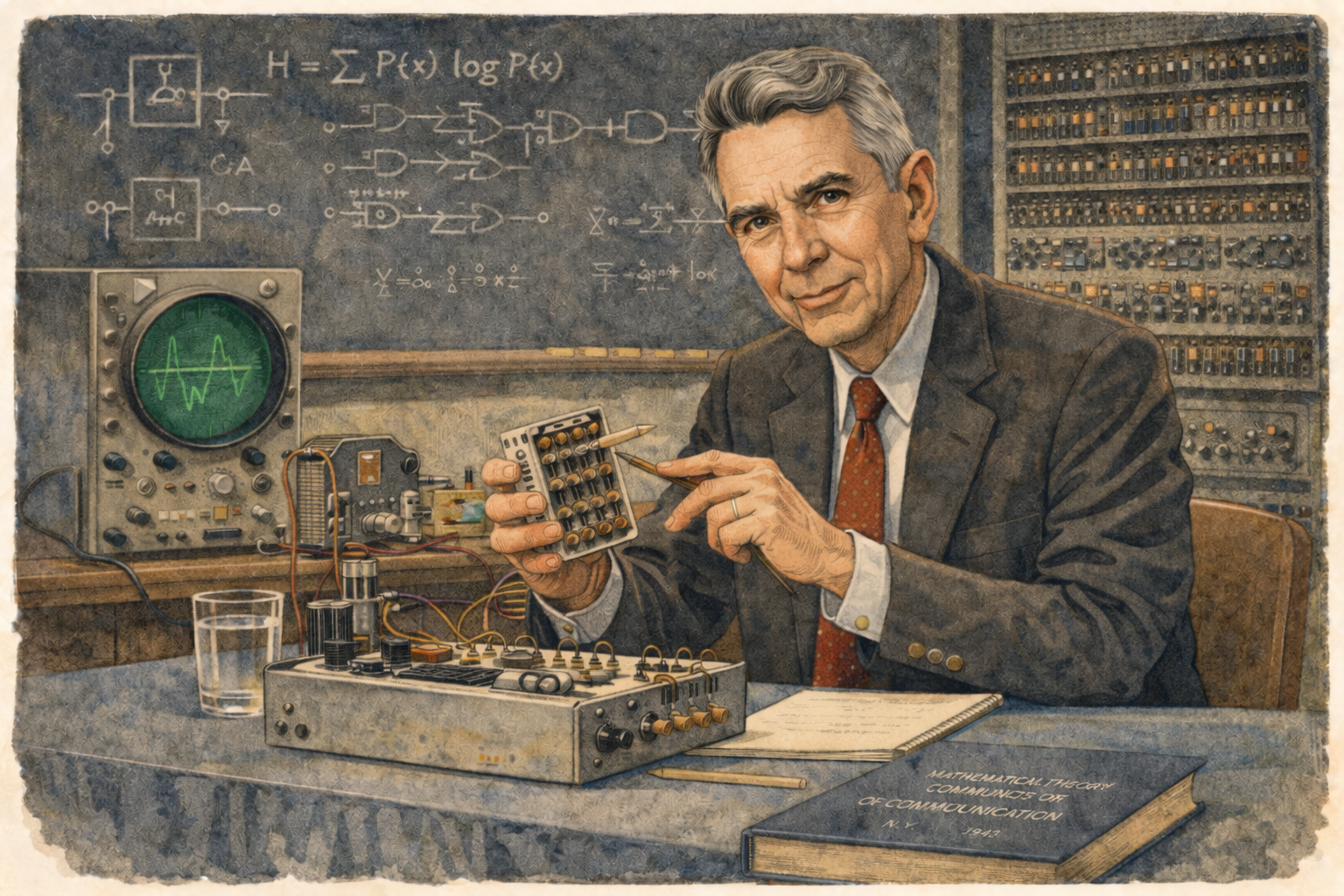
Claude Shannon
MATHEMATICIAN, ENGINEER, AND ARCHITECT OF THE INFORMATION AGE
The man whose 1948 paper transformed how humanity understands communication itself, known for founding information theory, giving the world the "bit," and laying the mathematical groundwork for everything from digital circuits to the internet. Shannon brought rigorous abstraction, restless curiosity, and a tinkerer's joy to everything from wartime cryptography to chess-playing machines to the question of what makes a mind truly creative.