
Naval Ravikant on
Wealth, Happiness
& the Meaning of Life
Naval Ravikant, angel investor, philosopher of Silicon Valley, creator of AngelList, sat down with Joe Rogan for a conversation that became one of the most shared and referenced episodes in the podcast's history. Rogan introduced him as a rare figure: someone deep in the tech world who has also developed a remarkably balanced perspective on how to actually live. Naval's response was characteristically self-deprecating: people find him interesting the way they'd find a bear on a unicycle interesting. It's the unexpected combination that captivates.
What followed was a sweeping, two-hour meditation on wealth, happiness, desire, education, automation, meditation, the meaning of life, and why the most powerful thing you can do in the modern world is learn to sit still. Naval drew on Buddhist philosophy, evolutionary biology, information theory, and thirty years of personal experience building companies from nothing, having arrived in America as a first-generation immigrant with, as he put it, not two cents to rub together. The conversation has the quality of a philosophy lecture disguised as a casual chat between friends. Nearly every segment contains a principle worth returning to again and again.
The Three Things Everybody Wants
Naval opens with a challenge to the modern obsession with specialization. He draws on the ancient Greeks and Romans, who expected a person to move through a full arc of life, school, war, business, government, philosophy, rather than narrowing into a single lane. His friend's line, "specialization is for insects," becomes a manifesto for the examined life: you have one shot at consciousness, so try everything.
He extends this into what he calls the mountain-climbing analogy. Most people spend their lives ascending a single peak. They get two-thirds of the way up, see that the summit is unreachable from their current path, and refuse to descend. The truly great creators, the Elons, the Madonnas, the Paul Simons, have the courage to climb back down and find a new route, knowing that their existing fans will hate them for it and that they'll look foolish as beginners again.
The Trap
- Clinging to sunk costs on a single path
- Refusing to look foolish as a beginner
- Defining yourself by one skill or title
- Peaking early and then defending the peak
Beginner's Mind
- Embracing the willingness to start over
- Living for the aha moment: connecting two ideas that hadn't been connected before
- Accepting that your children's "why?" reveals the limits of your own understanding
- Building a steel framework of understanding, not a scaffolding of memorized facts
I live for the aha moment: that moment when you connect two things together that you hadn't connected before, and it fits nicely and solidly, and it helps form a steel framework of understanding in your mind.
Naval RavikantNaval was raised by a single mother in a tough New York neighborhood. She used the local library as a daycare center, drop him off after school, pick him up late at night. He read everything: every magazine, every book, every map. This gave him a radically different relationship with reading. He stopped treating "books finished" as a vanity metric and started treating reading as a search for understanding.
Today, he keeps fifty to seventy books open on his Kindle at any time. He flips through them looking for ideas he doesn't yet understand. When he finds something interesting, he reflects, researches, chases it down through Wikipedia and blog posts. When he's bored, he drops it and picks up another. A great book might yield one page of reading in a night, followed by hours of thinking.
Naval's Reading Method
The approach is deliberately non-linear: don't read books in order, don't finish them, don't track them. Read to satisfy genuine intellectual curiosity. A good book is one that sparks reflection, not one that gets added to a shelf.
- Pick up a book, flip through it, don't start at page one
- Find an interesting idea, something you don't yet understand
- Reflect and research, chase references, follow threads
- When bored, switch, no guilt, no obligation to finish
- Re-read the best books, absorb them over years, not hours
On Kindle and iBooks simultaneously, bouncing between them based on curiosity
Rather than read all the books, absorb the best ones until they become part of you
No vanity metrics. Reading is about understanding concepts, not accumulating titles
Naval's famous tweetstorm of thirty-eight tweets, translated into dozens of languages, forms the backbone of this section. These are principles he developed for himself around age thirteen and has carried in his head for thirty years. They describe not how to earn income, but how to build true wealth: assets that earn while you sleep. The framework rests on four interlocking pillars.
Specific Knowledge
Knowledge that can't be trained for; it's found by pursuing your genuine curiosity. It's your unique combination of skills, interests, and personality traits that nobody else has. Society can't figure out how to get it other than through you.
Accountability
Put your name on the line. Take risk under your own name so you capture the rewards. The most powerful wealth creators are individual brands: Oprah, Elon, Rogan. Eponymous names that can't be replaced.
Leverage
Capital, people, or most powerfully, products with no marginal cost of replication. Code and media are the new leverage. A podcast works for you when you sleep. An app serves millions without you lifting a finger.
Equity
You must own a piece of a business: as an owner, investor, shareholder, or brand-builder. Renting out your time, even at $500/hour, won't make you rich. Your lifestyle creeps up with your income, and you never escape.
You're not going to get rich renting out your time. Even lawyers and doctors who are charging three, four, five hundred dollars an hour are not getting rich because their lifestyle is slowly ramping up along with their income.
Naval RavikantNaval predicts that the information age is reversing the hierarchies created by industrialization. We evolved as self-directed hunter-gatherers. Factories created bosses and schedules. But technology is now shrinking the optimal size of firms: every transaction that used to require a full-time employee can increasingly be done with an app, a rating system, and a contract. He envisions a future where high-quality creative work is available in a gig fashion: your phone buzzes with five job offers in the morning, you pick one, get paid, get rated, and then go to Tahiti.
This is the beating heart of the conversation. Naval frames happiness not as a byproduct of success, not as a personality trait, but as a skill, as trainable as fitness, as deliberate as learning to code. He draws on Buddhist philosophy to define desire as a contract you make with yourself to be unhappy until you get what you want. The more desires you accumulate, the more axes you have on which to suffer. His prescription: pick your one overwhelming desire, and on all others, let go.
The distinction he draws between peace and happiness is one of the most memorable moments in the episode. Peace, he says, is happiness at rest. And happiness is peace in motion. A peaceful person can convert peace into happiness anytime, simply by engaging with something they love. But a busy, striving, desire-laden person can never convert their restless activity into peace.
Desire is a contract you make with yourself to be unhappy until you get what you want.
Naval RavikantDeclare It Publicly
Use the power of social consistency. Tell your friends you're a happy person. Just as publicly declaring "I'm done drinking" makes you serious, declaring happiness creates a contract you'll live up to.
Watch Every Thought
Meditation isn't just sitting with eyes closed. It's 24/7 awareness. Watch what your mind does without judging or controlling it. Ask: does this thought serve me? Or is this conditioning from when I was ten?
Reframe Every Negative
Train yourself to find the positive interpretation of every moment. Someone dumps hundreds of photos on your phone: annoying, or generous? Do this enough and it becomes second nature. Positive thoughts are easy to release; negative ones linger.
Peace is happiness at rest, and happiness is peace in motion. You can convert peace to happiness anytime you want.
Naval RavikantNaval takes the contrarian view on automation and Universal Basic Income. Automation, he argues, has been happening since the dawn of time. Electricity put lamp-lighters out of work, the printing press disrupted the scribes, factories replaced artisans. New jobs are always created, always better, always more creative, and always impossible to predict in advance. Ten years ago, "podcast host" and "video game commentator" would have been laughed out of any career counseling office. The question isn't whether new jobs will exist; it's how quickly we can retrain people for them.
The Slippery Slope
The moment people can vote themselves money in a democracy, $15K becomes $20K becomes $25K. In a system where the bottom 51% can vote themselves everything the top 49% has, it's a straight slide into bankruptcy.
Cost Prohibitive
$15K/year for everyone would cost approximately three-quarters of current GDP, and GDP would shrink as entrepreneurs fled the tax burden. You would essentially bankrupt the country.
No Meaning
People who are struggling need status and purpose, not just cash. The moment you put someone on the dole, you've lowered their status and made them a second-class citizen. You have to teach a person to fish.
Needs Means-Testing
It's nonsensical to hand $15K to millionaires. You have to figure out who needs it and who doesn't, which brings you right back to the welfare system you were trying to replace.
Naval navigates the capitalism-socialism divide with unusual nuance. He acknowledges that monopolies, crony capitalism, and the banking sector's habit of privatizing gains while socializing losses have given capitalism a terrible reputation. But he insists that free exchange is intrinsic to human nature, going back to the first person who offered to share cooked deer around a fire. The correct criticism of capitalism is when it fails to provide equal opportunity. The dangerous confusion is between equal opportunity and equal outcome.
The Nassim Taleb Scale
Naval's favorite framing of when each political philosophy applies. The key insight: the larger the group of people with differing interests, the less trust there is, the more cheating there is, and the more you need well-aligned incentives, which means capitalism. The smaller and more intimate the group, the more naturally socialist you can be.
Wealth creation isn't zero-sum. When you create something new and trade it for something I've created, there's higher utility for both. The pie grows.
Naval points out that enforcing equal outcomes requires someone with a gun. Free people make different choices, and different choices produce different outcomes.
If you want to be a real socialist, great. Open all your doors and windows tomorrow. Please, everybody, come take what you want. See how that works out.
Naval RavikantNaval diagnoses the central paradox of modern life: all of our diseases have flipped from scarcity to abundance. Centuries ago, a piece of sugar was precious; now it's weaponized into a thousand irresistible forms. A piece of gossip was useful intelligence; now it's an addictive 24/7 firehose injected into your skull via clickbait. The human brain was not designed to absorb every breaking emergency on earth in real time. And the best minds of our generation are employed to make sure we can't stop.
He extends this to media itself: the internet commoditized facts, forcing news organizations to pivot from reporting into opinion-peddling and tribal warfare. He sees a future of one hegemon (Facebook, the New York Times) and millions of independent creators, with everything in between dying. The illusion of journalistic objectivity is gone. What remains are shock troops fighting culture wars through their respective media organs.
Weaponized Sugar
Food scientists have engineered sugar into forms you can't resist, converting an ancient survival advantage into a modern epidemic.
Weaponized Attention
Social media companies employ lab-coated researchers to addict you. You are the Skinner pigeon, clicking and clicking and clicking.
Weaponized Stimulation
Video games, porn, drugs, news, each one an engineered superstimulus, and you stand alone against entire industries designed to hook you.
The way to survive in modern society is to be an ascetic. It is to retreat from society. There's too much society everywhere you go.
Naval RavikantNaval reduces meditation to its absolute essence: sit down, close your eyes, and do nothing. No app, no technique, no breath-counting, no headband that chirps when you're in "deep meditation." Just sit. Whatever happens happens. If you think, you think; if you don't, you don't. No effort in either direction. The entire practice is this simple. And this terrifying.
The terror comes from what happens when you stop. Naval compares the mind to an overflowing email inbox stretching back decades: unresolved situations, avoided conversations, buried regrets, unexamined preferences. When you sit in silence, those emails start surfacing. Most people quit here, saying "it's not working, I can't clear my mind." But this is the practice; it's self-therapy, listening to yourself instead of paying a therapist to listen to you. And if you stick with it, at least an hour a day for at least sixty days, you work through the backlog until the only thoughts left are from yesterday.
The Email Inbox Metaphor
Everything that happens to you in life gets partially processed, partially absorbed, and partially ignored. The ignored portion piles up like unanswered emails, going back ten, twenty, thirty, forty years.
- Phase 1: You sit down. The old emails start flooding back, regrets, unresolved conflicts, avoided questions.
- Phase 2: It's uncomfortable. People flee. "It's not working. I can't clear my mind." This is actually the practice working.
- Phase 3: Self-therapy. You listen to each email, process it. Not necessarily resolve it, but at least hear yourself.
- Phase 4: Inbox zero. The only things left are yesterday's thoughts. This is when real meditation begins.
Naval recommends at least an hour a day for sixty days before the backlog clears enough for silence to appear
It's watching your own thoughts all day long, like watching anything else in the outside world
What Meditation Is Not
- A signaling game for social media
- Something that requires an app or technology
- A competition for "chirps" or minutes logged
- About achieving or craving any specific state
What Meditation Is
- Literally the art of doing nothing
- Self-therapy, listening to yourself instead of a therapist
- A 24/7 practice of witnessing your own thoughts
- The path to peace from mind, not peace of mind
All of man's problems arise because he cannot sit by himself in a room for 30 minutes alone.
Blaise Pascal, quoted by NavalNaval attacks the biggest question of all, and arrives at a liberating conclusion. He introduces Agrippa's trilemma: any chain of "why" questions inevitably terminates in one of three dead ends. There is no bottom to the well. And that, he argues, is what makes us free. If there were a single answer, we would all be trapped, competing to fulfill it, signaling who does it better. But there isn't, so you get to make your own.
Infinite Regress
"Why?" "Because of this." "Why that?" "Because of that." The chain of questioning never ends. You can keep asking forever, and every answer spawns another question.
Circular Reasoning
"A because of B. B because of A." You're trapped in a loop. The reasoning references itself and offers no exit.
Axiom
"Because God." "Because the Big Bang." "Because simulation." These are all stopping points, ways of saying "the chain ends here." None is more fundamental than any other.
If there was a single answer to the meaning of life, we would not be free. We would be trapped. You get to make up your own answer, and that's the beauty.
Naval RavikantThe conversation closes with Naval's most practical wisdom, with the kind of advice that rearranges how you think about your daily life. He redefines retirement, introduces the concept of an aspirational hourly rate, and makes the case that authenticity is the ultimate competitive advantage.
Retirement is when you stop sacrificing today for some imaginary tomorrow. When today is complete in and of itself, you're retired.
Naval RavikantPath 1: Financial Freedom
Save enough that passive income from investments covers your burn rate. Keep your burn rate low. This is the most common path, and the slowest.
Path 2: Asceticism
Drive your burn rate to zero. Become a monk. This is the fastest path, and the one almost nobody takes.
Path 3: Passion
Do something you love so much that it's not about the money. Today is already complete. This is the path Naval advocates most strongly, and the one he's found himself on.
The Aspirational Hourly Rate
Naval's brilliant hack for protecting time: pick an hourly rate for yourself that is deliberately ludicrous, aspirational, not realistic. His started at $500/hour, then he upgraded to $5,000. Then ruthlessly apply it to every decision:
- If a task pays less than your rate, hire someone else to do it
- If standing in line to return something costs more than the item, give it away
- Meetings become prohibitively expensive. Most should be phone calls, phone calls should be emails, emails should be texts
- Business travel is almost never worth it. Naval hasn't traveled for business in over five years
Deliberately ludicrous. The point isn't accuracy, it's protecting your most irreplaceable resource
He only travels if the trip itself will be joyful, not for any meeting, which he says never amounts to anything
I'm always "working", but it looks like work to them and feels like play to me. And if they want to compete with me and they're going to work, they're going to lose.
Naval RavikantIn His Own Words
Defining quotes from the conversation
Desire is a contract you make with yourself to be unhappy until you get what you want.
You're not going to get rich renting out your time. You must own equity, a piece of a business, to gain your financial freedom.
On WealthPeace is happiness at rest, and happiness is peace in motion. You can convert peace to happiness anytime you want.
On HappinessIf you're so smart, how come you aren't happy? That's my challenge to all the people who think they're so smart.
On IntelligenceRetirement is when you stop sacrificing today for some imaginary tomorrow. When today is complete, you're retired.
On RetirementA clear mind leads to better judgment, leads to a better outcome. Learn to tame your mind like you've tamed your body.
On Mental ClarityI'm always "working", but it looks like work to them and feels like play to me. If they compete with me by working, they'll lose.
On Authentic WorkThe way to survive in modern society is to be an ascetic. It is to retreat from society. There's too much everywhere.
On Modern LifeIf all of your beliefs line up into one political party, you're not a clear thinker. They're taken from other people.
On Political ThinkingI would rather read the best 100 books over and over until I absorbed them, rather than read all the books.
On ReadingEvery man has two lives, and the second starts when he realizes he has just one.
Confucius, Quoted by Naval🎙️ The Joe Rogan Experience
Launched in 2009, The Joe Rogan Experience is one of the most popular podcasts in the world, hosted by comedian, UFC commentator, and curious conversationalist Joe Rogan. The show's long-form format, often running two to three hours, allows guests to explore ideas with a depth and spontaneity rarely found in traditional media. Rogan's guest list spans scientists, philosophers, athletes, comedians, authors, and entrepreneurs, making JRE a sprawling, unscripted seminar on modern life. Episode #1309 with Naval Ravikant became one of the show's most shared and revisited episodes.
⚡ Why This Episode Endures
JRE #1309 became one of the most shared and referenced episodes in the show's history because it distills decades of reading, building, and self-examination into a single conversation. Naval's ability to move between Buddhist philosophy, evolutionary biology, information theory, and hard-won entrepreneurial wisdom, while remaining accessible and concrete, created something closer to a philosophy lecture than a typical podcast interview. Nearly every segment contains a principle worth returning to, and the episode has become a kind of secular scripture for a generation of builders, thinkers, and seekers.
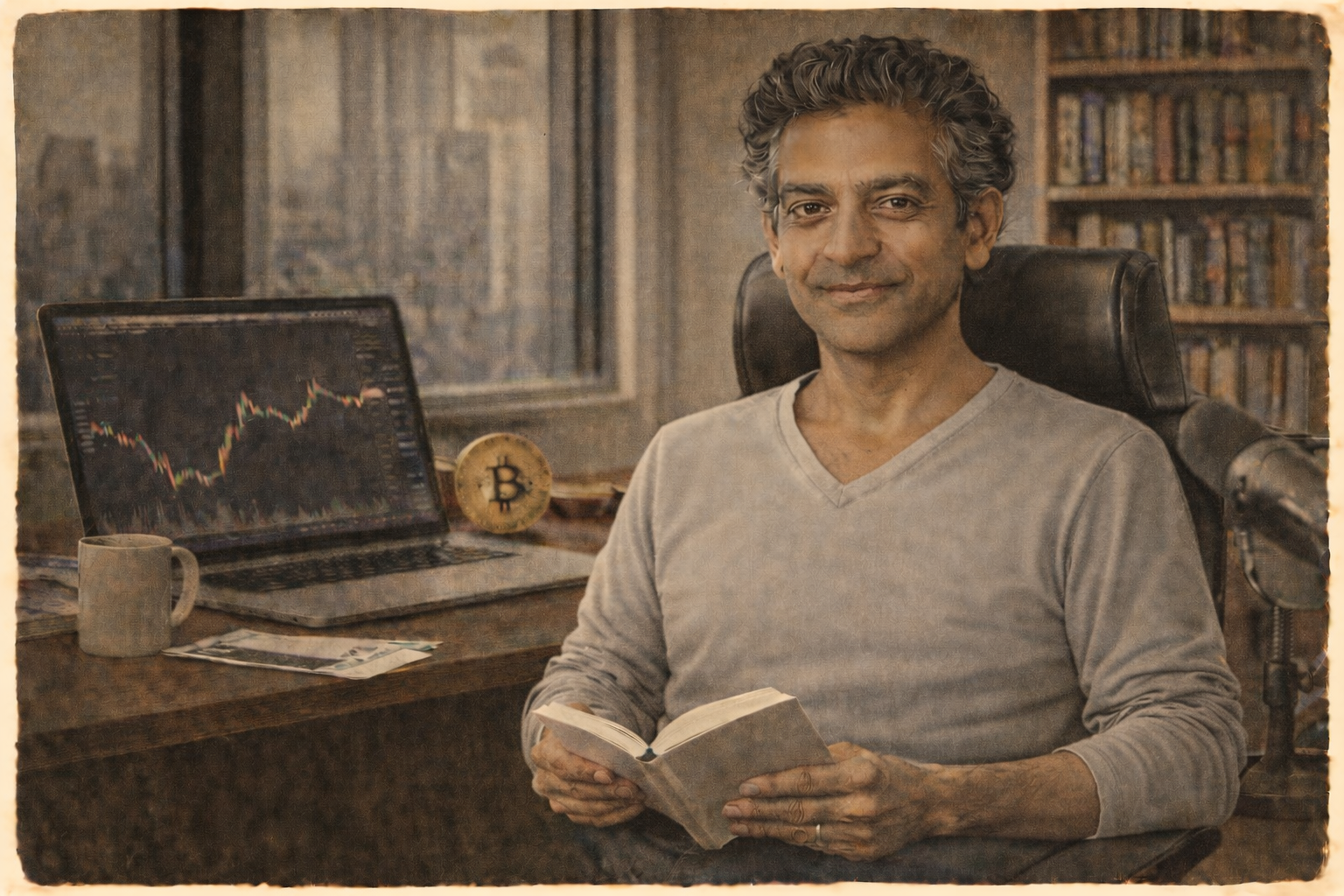
Naval Ravikant
ENTREPRENEUR & PHILOSOPHER
Angel investor, entrepreneur, and deep thinker on wealth, happiness, and the examined life. Naval distills complex ideas about leverage, knowledge, and inner freedom into their sharpest possible form.