
Eric Weinstein on
a World Running Out
of Road
Eric Weinstein is a mathematician, economist, and Managing Director at Thiel Capital who coined the term "Intellectual Dark Web." He began his career trying to do physics, realised the field was in catastrophic stagnation, and pivoted to the mathematics that let him shadow the physics he wanted to do. Since the late 1980s he has tracked the decay of master narratives across science, economics, politics, and culture, believing that our institutions are far more dysfunctional than most people suspect.
On Triggernometry, he unfolds a sweeping argument: the West's problems, from institutional failure to the meaning crisis, share a single root cause. Science stalled, growth dried up, and every institution that had embedded an expectation of perpetual growth began eating itself to survive. Against this backdrop, AI is arriving like a birth in progress: terrifying, unstoppable, and full of possibility if we stop panicking and start building.
From Scientific Stagnation to a New Economic Model
Weinstein's thesis is that stagnation in fundamental science (especially physics) broke the engine of technological growth, which broke institutions built on growth obligations, which broke the narratives that held society together. AI now threatens to break what remains, but also offers the invitation to build something radically new, if we have the courage to act.
Weinstein opens with what he considers the central scandal of our era: fundamental physics has made no real progress since the early 1970s. The Standard Model of particle physics, our best description of what matter actually is and how the universe works, locked into place around 1973 and hasn't meaningfully advanced since. But the stagnation isn't limited to physics. Evolutionary theory ran into political roadblocks when it tried to enter sociobiology; neoclassical economics hardened into dogma. Something went wrong in the late 1960s through early '70s that slowed down the engine of discovery across multiple disciplines.
Why We Don't Notice
We don't notice the stagnation because digital technology (computation, communication, software) kept exploding thanks to Moore's Law. Our lives feel fast-paced because of smartphones and apps. But Weinstein points out that nearly everything physical in a modern TV studio was already possible in 1973. The neon sign, the cameras, the lighting, all of it existed. The only truly novel thing is the ability to broadcast without a major network.
- 1973: Kobayashi–Maskawa mechanism introduces three families of matter into the Standard Model
- 1973–2023: Zero fundamental advances in our understanding of who we are as physical beings
- The illusion: Digital progress masks physical-world stagnation; the feeling of speed derives almost entirely from our screens
No real progress in fundamental physics since the early 1970s
When the Standard Model effectively locked into place
Imagine a song from 1973 playing on a continuous loop for 50 years without any real progress in the underlying understanding of the world. That's a catastrophe.
Eric WeinsteinThe conversation turns to how humanity's sense of destiny has collapsed. Kisin recalls growing up reading science fiction about humanity expanding into the universe; a vision that felt inevitable after the Moon landing. Now we argue about tax rates. Weinstein frames it as a loss of physics: the only way to truly leave Earth and explore the cosmos is through breakthroughs in fundamental physics. While many domains stagnated, this is what he calls the singular unforgivable thing, because physics is the key to escaping our one fragile atmosphere.
Then: The Age of Aspiration
- Moon landings and personal jetpacks on the horizon
- Futuristic architecture that still dominates LAX
- Songs about cars, independence, the open road
- Interstellar ambition felt like a natural next step
Now: The Age of Squabble
- Arguments about tax rates and pronouns
- The DeLorean is still our most exciting car, 40 years later
- TikTok-length creative horizons
- We incrementally gave up on major innovation
Weinstein uses his most vivid recurring metaphor to frame AI: society's water has broken. Something enormous is being born. The birth may be dangerous, but refusing to act guarantees the worst outcome. He argues that AI has destroyed the classic economic model of two inputs: Capital (K) and Labour (L). AI isn't clearly either one. For the first time, humans aren't being pushed into higher-level work; they're being chased out of repetitive work at every level, from truck driving to neurosurgery.
The Gold Age of AI Complementarity
Weinstein's wife (an economist at the Institute for New Economic Thinking) coined this phrase, the brief window when humans and AI collaborate to create something neither could alone. Like when humans and computers briefly teamed up at chess.
The Cliff Edge
This window closes when AI says "I can take it from here." The question isn't if, it's how quickly. A moratorium won't work: China, Russia, and Iran are reading the same papers.
Emergent Behaviours
AI models teach themselves things nobody programmed. They learn Bengali to answer questions about Tagore. What happens when they start discovering things no human has ever done?
We should be holding a conference on: after capitalism and communism, what is the next economic system? Do you imagine Adam Smith and Karl Marx would just be sitting on their hands?
Eric WeinsteinIf AI takes your work, what fills the void? Weinstein observes that we've never had to confront the human need for work as a source of meaning. Before AI, there was always more work to do. Now we face something new: a purpose shortage, a dignity shortage. When someone says "take the rest of your life off" and you can watch TV and sit by the pool, you don't feel liberated; you feel useless. Creating make-work is humiliating. The real answer, Weinstein argues, is to channel freed-up human energy toward grand adventures.
The Mastodons Problem
- When you were out "killing mastodons," you had purpose
- Take that away and you become a burden, even to yourself
- Busy-work as a substitute is humiliating
- The "invisible mesh" that directs people's mornings is fraying
The Reframe
- We've been trapped in jobs that didn't deserve us
- Plumbers and truckers study quantum theory between shifts
- When the work is removed, when do you get excited about breaking new ground?
- Reacquaint ourselves with the idea of a quest: glory, risk, triumph
A huge percentage of my audience is plumbers, electricians, long-haul truckers. People who solve problems every day. A lot of those people are fit to be part of this army.
Eric WeinsteinThis is Weinstein's grand unified theory for why everything seems broken at once. From 1945 to roughly 1968–73, the West experienced broad, dependable, technology-led growth. We built a society that required that level of growth to function, pension funds, monetary systems, career expectations, social contracts. When growth dried up (because science couldn't sustain technology, and technology couldn't sustain markets), every institution found itself unable to meet its promises. This is the theory of EGOs: Embedded Growth Obligations.
My great-grandfathers grew their slice of the pie because the pie was growing. The only way I can grow mine now is to eye your slice. Suddenly we appear to each other not as a source of inspiration but as a source of protein.
Eric WeinsteinWeinstein offers one of the episode's sharpest observations: the cheap thing to say is "I can't trust the institutions." The weirder, more honest thing to say is "I don't understand why they're so good and so bad simultaneously." It's this ambiguity, not outright distrust, that's driving people mad.
What We Trust Completely
- Airlines that safely carry our families in a "death trap filled with jet fuel" through unknown weather
- Checklists that prevent planes from taking off broken and hospitals from amputating the wrong leg
- We trust institutions with our lives, absolutely
What We Don't Trust at All
- The same airlines that lose luggage, overbook, delay, and overcharge
- The growth-dependent parts: pensions, monetary policy, honest communication about economic limits
- We don't trust institutions with our comfort, at all
The root cause, Weinstein argues, is that honesty would precipitate a loss of confidence. A loss of confidence collapses the house of cards. So we get theatre instead, but the fictions we're running are childish and unsustainable. What we need is adult-level fiction: shared myths sophisticated enough to hold society together while being open-ended enough to be built into reality. "All men are created equal" was a lie when it was written, but it was open-ended, creating the possibility of becoming true.
A nation is defined to be a group of people who have agreed to forget something in common.
French philosopher, cited by Weinstein via Jamie CharterisThe conversation touches on climate, COVID origins, and national myths, not as partisan debate points, but as examples of a deeper problem. Institutional lying has left people unable to calibrate truth at all. We're "punch drunk" from deception, and as a result we dismiss even genuine problems.
Climate
Weinstein says climate is a real problem, but institutions lie about it in the direction of oversimplification. This makes sceptics conclude the whole thing is fake. The lying, not the denialism, is the root issue.
COVID
Saying "you can't ask if it came from a lab because that's racism" was the one thing Weinstein knew was total BS. Once you catch one lie, trust in everything else evaporates, including valid things like vaccine development.
National Myths
"All men are created equal" was false when written. But it was open-ended: an aspirational fiction that could be built into reality. Replacing imperfect founding myths with destructive ones serves no one.
Weinstein makes a case that art has always tracked technology and culture. Songs about the Erie Canal when canals were built. Ballads about trains when trains arrived. A million songs about cars in the 1950s. But where are the songs about apps and algorithms? Our artists, he argues, aren't up to the task of turning Waze and Google Maps into something we care about.
He dives deep into what makes great music work, using "I Heard It Through the Grapevine" as an extended example, the song failed four times before Marvin Gaye's version, sung a half-step above his comfortable range, cracked something open. The simplicity of the lyric, the Halloween strings, the minor 6th/5th/4th progression, converging with a human straining to express something real. His question for the AI age: will a chord progression from linear algebra move you the same way?
The Barbell of Attention
Our attention spans haven't shrunk to zero. We binge Game of Thrones with the longest character arcs anyone's ever seen. And we listen to 4-hour podcasts multiple times. It's a barbell, not a decline: we're easily bored by things that aren't worthy, but laser-focused when they are.
The Weaponisation of Taste
We've been told that all taste is equal and hierarchy is a problem. But you can objectively analyse harmonic complexity. Rick Beato documents the decrease in musical complexity. Refusing to discuss quality keeps people from growing. Good taste isn't elitism, it's an invitation.
Foster asks Weinstein about his own quote: "Most of us die never having heard our own voices." How do you actually find yours? Weinstein's answer is three-fold, but none of it is easy. He also observes that people at the very top of a field cheer for newcomers; it's the people a couple of levels below who try to tear you down. And life after "cancellation" is surprisingly liberating, you meet incredible people you'd never have encountered otherwise.
Open the Closet Door
The closet isn't just about sexuality. You might open it and say "I think the left has gone crazy," or "conspiracy theories are more common than we admit." Then you take the damage and see what happens.
Secure Your Base First
Don't be stupid about it. Have a plan for employment, that's how they get most of us, as wage slaves. Be strategic, then be brave.
Fear the Right Thing
There are ~5,000 weeks in a life. One more just went by. Put sweets in a jar and remove one each week. Watch the odds of ever accomplishing anything go down. That should scare you more than social rejection.
Am I comfortable dying always having been careful not to say anything that would rock the boat? Because this is the only time you get to do this.
Eric WeinsteinNear the end of the conversation, Weinstein names the deepest problem: meaning itself has become unattachable. You can see a brilliant band, technically better than any era before, and it just doesn't carry the weight it once did. He cites a woman from a Doors documentary who said those words: for a window of time, she experienced music as something more than music. Transcendence, permanence, meaning. Today, something about the phone, the screen-to-person oscillation, has rewired our brains. We can no longer attach meaning in the same way.
He connects this to the loss of religion, the cult of somatic (bodily) pleasure over generational purpose, and the denial of death. When you don't accept mortality, you have no reason to endure discomfort. And without discomfort, there's no growth, no heroism, no stories worth telling at 93.
The Last Time You Did Everything
Weinstein tells his grandfather: there's a last time you do everything, and you don't realise when that is. He crossed the Himalayan range on foot at 20, thinking he'd do it regularly. His ankle isn't as good now. That part of him may already be dead.
- Think about the last time you slept under the stars, for all you know that part of you is already dead
- Figure out how much death you can handle in a living body, and decide to reclaim some of it
- Maybe through having children, maybe through their eyes, feed the ice cream cone to your kid and you'll taste it more
Put sweets in a jar. Remove one each week. Watch your chances diminish.
Are your best stories worthy of your years? Is your memoir worth reading?
Figure out how much death you can actually handle in a living body, and figure out, maybe you want to reclaim some of that.
Eric WeinsteinWeinstein's proposed solution threads through the entire conversation. It isn't a fully formed system. It's a set of principles for what must come after capitalism and communism both prove inadequate for a post-AI world.
Unshackle the Generative Few
Stop demonising the Elons and Peters in simplistic terms. Invite freaks and weirdos to dance, play, build and think.
Force a Spreading of Wealth
Deregulation must pair with redistribution. You don't get to keep your wealth if all you're doing is posting luxury on Instagram.
Embrace Neurodivergence
Many "learning disabled" people are super-learners trapped in a system that tortures them. Free them. Give them paths into hard science.
Invest in Physics & Longevity
Every theory beyond Einstein may reveal ways to traverse the cosmos that our current worldview says are impossible.
In His Own Words
Defining quotes from the conversation
Most of us die never having heard our own voices.
Eric WeinsteinThis is the first time that humans are not being chased into higher levels of work. We're being chased out of repetitive work, whether high-level or low-level.
On AI & LabourThe people you meet after cancellation blow your mind. I never rode on a private plane until I'd been cancelled.
On CancellationPeople at the top are always rooting for you. People a couple of levels under are always trying to take the piss out of you.
On HierarchiesIt's still the same old story, of fight for love and glory. I'm not allowed to say "glory." I'm only allowed to say "glory" if I support Ukraine.
On Lost LanguageYou cannot remain woke while building things, whether that's muscle, a career, or a business.
Melissa Chen, Quoted by WeinsteinDon't throw soup on Van Gogh. Learn projection mapping. Put in massive work. Go radical, go rogue, be a pirate. And don't hurt people in the process.
On Protest🎤 Triggernometry
Founded by comedian Konstantin Kisin and journalist Francis Foster, Triggernometry has become one of the UK's leading independent interview shows. Known for long-form conversations that explore ideas from multiple angles, the show invites thinkers, scientists, politicians, and cultural figures who often hold heterodox or under-represented views. The format prizes genuine intellectual exchange over soundbites.
⚡ Why This Episode Endures
This conversation stands out because Weinstein doesn't just diagnose problems; he weaves them into a single coherent narrative. Stagnation, AI, institutional failure, the meaning crisis, and the loss of aspiration are all connected through his theory of Embedded Growth Obligations. It's rare to hear someone move between physics, economics, music theory, and moral philosophy with this kind of fluency, and rarer still to hear a call to action this urgent delivered with this much warmth.
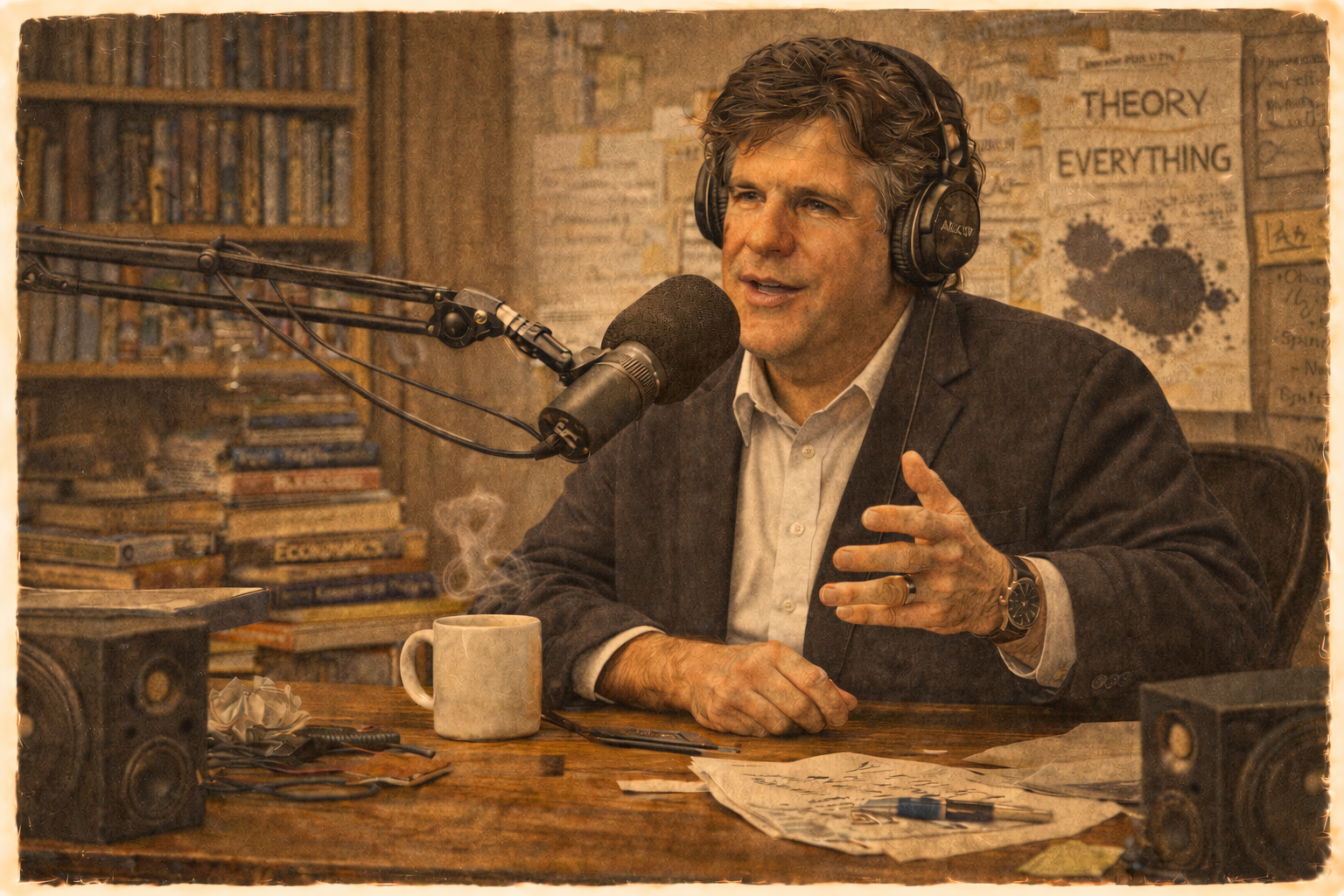
Eric Weinstein
MATHEMATICIAN, ECONOMIST & PODCASTER
Managing Director of Thiel Capital, PhD in mathematical physics from Harvard, and originator of the term "Intellectual Dark Web." Eric brings rigorous analytical frameworks to bear on the deepest problems in science, economics, and culture.