
Stephen Fry on the
Future of Humanity
& Technology
Stephen Fry, actor, writer, and self-described "curious mind", stood before an audience of scientists at Nokia Bell Labs, the birthplace of information theory, and delivered a lecture that was at once a love letter to human creativity and a warning about its consequences. He opened with a disarming admission: he is no computer scientist, no coder, no programmer. What he offered instead was something rarer and perhaps more urgently needed: the view from the humanities, at the exact moment when the humanities are being pushed to the margins.
The lecture is built on a single, devastating insight: exponential technological power is converging at the precise moment when human wisdom is most fragmented. Fry frames this through two ancient parables: Prometheus and Pandora (which explains why we create dangerous technologies) and the Chessboard and the Rice (which explains why we can't see the consequences coming). Together, they form the mythological backbone of an argument about building superintelligence in an age of tribalism, designing minds without understanding minds.
Two Ancient Myths for the Modern Age
Fry charts his own personal arc from internet utopian, marveling at the miracle of Wikipedia, the energy of early Twitter, to a disillusioned witness of algorithmic echo chambers, surveillance capitalism, and weaponized misinformation. The internet didn't just fail to deliver on its promise; it amplified the darkest parts of human nature while enriching a handful of corporations.
The Utopian Promise
- The greatest gathering of human knowledge in history
- Wikipedia as a new Enlightenment
- Twitter as a tool for democratic revolution
- Connection across borders, languages, cultures
- Open access to education for everyone on Earth
What Actually Happened
- Post-truth, fake news, and algorithmic radicalization
- Big data harvesting of every preference and spending pattern
- Echo chambers and filter bubbles that tribalize and ghetto-ize
- Cyberbullying, body shaming, and grooming of the young
- The slavery of the gig economy
Fry's second founding myth of the chessboard and the rice becomes the engine of this section. He devotes it to a single, terrifying idea: humans think linearly, but our technology grows exponentially. One grain doubled sixty-four times spirals beyond comprehension so quickly that the emperor, who laughed at the "humble" request, discovers it would bankrupt his entire kingdom. Moore's Law, Fry argues, is our chessboard. We're somewhere around square 45.
The Stadium Filling with Water
Imagine a stadium sealed at the top. A single drop of water falls, and the volume doubles every minute. This is Fry's most vivid illustration of why exponential growth is so dangerous. It looks like nothing, until it's everything.
- At minute 10, the stadium is 0.1% full. Barely a puddle.
- At minute 25, it's still only 0.3%. Nothing to worry about.
- At minute 40, just 2%. Still looks manageable.
- At minute 45, only 7%. Warming up, but surely we have time?
- At minute 49, it overflows completely. You had four minutes.
The final square of the chessboard demands 2⁶³ grains, roughly 18.4 quintillion. More rice than has been produced in all of human history combined.
A 1971 Volkswagen Beetle cost $2,000 and went 50 mph. If it followed the same doubling curve as transistor density, it would now cost a fraction of a penny and approach twice the speed of light.
The stadium goes from 7% full to completely overflowing in just four minutes. This is the nature of exponential change: the crisis arrives long after the point where it could have been prevented.
Fry traces a sweeping historical arc from ancient mythology through the invention of information theory to the AI inflection point of our era. Technologies don't arrive alone; they converge. And each wave unlocks time for art and thought, which creates the next wave.
These aren't isolated topics. They form a tightly interconnected argument about why this particular moment in history demands a fundamentally different kind of thinking, one that bridges the sciences and the humanities.
The Promethean Bargain
Every transformative technology is a stolen fire: it illuminates and it burns. The internet promised enlightenment but delivered algorithmic tribalism alongside Wikipedia.
Exponential Blindness
Human brains evolved for linear thinking. We cannot intuitively grasp doubling, the most consequential force of our era is invisible to us until it's too late.
The Machine Intelligence Gap
Deep Blue conquered chess through brute force; AlphaGo through genuine learning. Each victory redefines what we thought was uniquely human.
Pandora's Internet
Fry charts his arc from utopian, marveling at Twitter and Wikipedia, to disillusioned witness of echo chambers, surveillance, and weaponized misinformation.
The Missing Philosophers
Tech companies recruit AI specialists at vast salaries but employ no philosophers. We're building minds without understanding what minds are.
Apollonian vs. Dionysian
Drawing from Nietzsche and Star Trek, Fry argues machines will be purely logical. Without the emotional dimension, they lack what makes consciousness meaningful.
Data as the New Oil
Whether it's DeepMind's training sets or Facebook's surveillance, data is the fuel of AI. Those who control the data control the future.
The Humility of Neuroscience
Free will may be illusory. Morality is hardwired instinct. Just as we learn we're not exceptional, we're about to create beings that might be.
Work, Leisure & Economics
Hunter-gatherers worked three hours a day. If machines do our labor, capitalism won't distribute the abundance. Universal Basic Income becomes urgent.
The Arts as Infrastructure
The more machines handle work, the more time we have to be human. Yet we're defunding the very disciplines that explore consciousness and meaning.
Drawing from Nietzsche's analysis of Greek tragedy and, unexpectedly, the crew of the USS Enterprise, Fry argues that sustainable intelligence, human or artificial, requires holding two opposing forces in tension.
Apollonian
- Rational analysis
- Mathematical precision
- Rhetorical clarity
- Systematic structure
to integrate both
Dionysian
- Creative intuition
- Bodily experience
- Empathic connection
- Chaotic energy
Fry's warning: if we create machine intelligence, it will likely be purely Apollonian: all logic, no passion. The question becomes whether a superintelligence without embodied emotion, without the Dionysian dimension, can truly be called intelligent at all. Or whether it will simply be an extraordinarily powerful optimiser with no understanding of what it means to be alive.
Fry is a master storyteller. The lecture follows a classical dramatic arc: seduction, betrayal, dread, recognition, determination, and stubborn hope. His power comes from his refusal to choose between pessimism and optimism; he holds both simultaneously.
In His Own Words
Technology is not a noun, it is a verb.
ON REFRAMING HOW WE THINK ABOUT TECHNOLOGYI would be the Prometheus who gives the divine spark to our creations.
HUMANITY BECOMING THE GODS, THE FULL CIRCLE OF THE MYTHThe extended audience exchange pushed back against Fry's darker conclusions and drew out his most nuanced thinking. By the end, the conversation had evolved from diagnosis to something closer to collaborative problem-solving.
On Asimov's Three Laws
Asimov's laws are "brilliantly distilled," but the deeper problem is that we can't even agree what justice means. How do we program ethics when morality is contested? The real test of machine intelligence isn't chess. It's whether a machine could genuinely laugh at a joke.
On Work & Economics
Harari's insight: hunter-gatherers worked three hours a day and were healthier. If machines take over labor, capitalism won't redistribute abundance voluntarily. Universal Basic Income and progressive robot taxes are necessary, but require political unity that tribalism prevents.
On Religion & AI
Religion has historically shrunk as science expanded, but science shouldn't be smug. Fry suggests moving toward Buddhist-inspired frameworks that address consciousness and impermanence without requiring a creator-god. The excitement of science lies in what we don't know.
On the War on Science
Better storytelling is the answer. Science is taught as formula and dogma, not narrative and wonder. Perhaps humans should learn science the way we teach machines to learn: through immersion, narrative, and pattern recognition, not memorized rules.
The lecture is remarkably nonsectarian, drawing from mythology, science, philosophy, fiction, and technology. Here's a map of the minds Fry invokes, organized by domain.
🔔 The Shannon Luminary Lecture Series
Named after Claude Shannon, the father of information theory who worked at Bell Labs, this lecture series invites prominent thinkers to reflect on the intersection of technology and society. Held at Nokia Bell Labs in Murray Hill, New Jersey, the same campus where Shannon and Turing crossed paths during WWII and where the transistor was born, the series is a deliberate attempt to bring humanistic reflection into the heart of the institutions building the future.
⚡ Why This Conversation Is Urgent
Fry delivered this lecture before the explosion of large language models, before ChatGPT, before the current global scramble to regulate AI. Every warning he issued has since accelerated. The philosophical vacuum he identified, the absence of ethicists and humanists from the rooms where AI is being built, remains largely unfilled. His call to redouble investment in the arts and humanities, to demand that philosophy be present alongside engineering, has only grown more pressing as the technology has outpaced the frameworks we need to govern it.
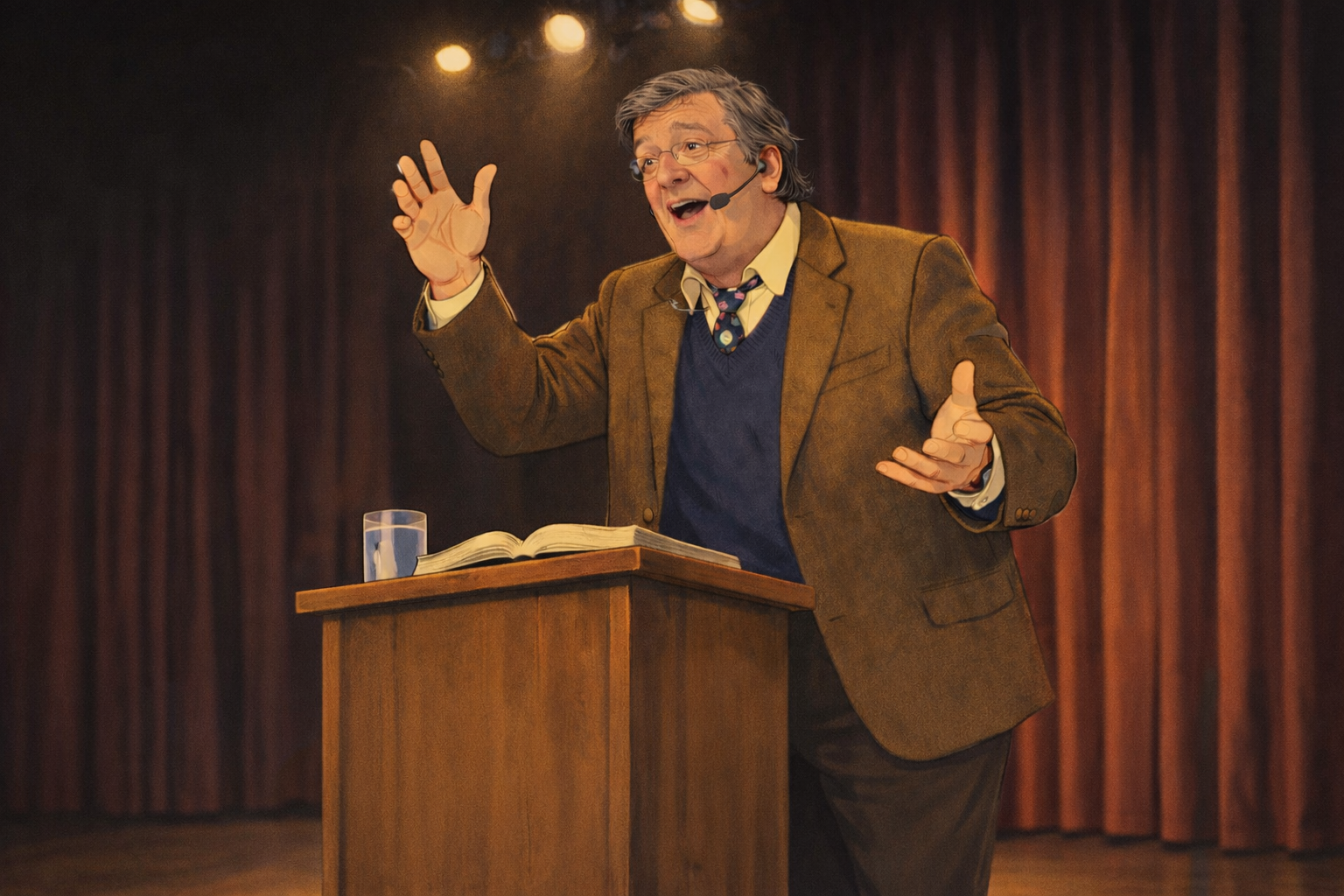
Stephen Fry
AUTHOR, ACTOR & BROADCASTER
Polymath, wit, and one of Britain's most beloved public intellectuals. Stephen weaves history, literature, and technology into a luminous case for human hope that is as erudite as it is moving.