
David Foster Wallace:
This Is Water
Two young fish are swimming along. They happen to meet an older fish swimming the other way, who nods at them and says:
"Morning, Boys. How's the Water?"
One of the young fish looks over at the other and asks: "What the hell is water?" This is the opening of what would become one of the most widely shared commencement addresses of all time, a 23-minute meditation on awareness, choice, and what it really means to be educated.
The point of the fish story is that the most obvious, important realities are often the ones that are the hardest to see and talk about.
Wallace opens by gently demolishing the standard commencement address. He isn't going to tell the graduates to be themselves or follow their dreams. Instead, he argues that the real value of a liberal arts education has nothing to do with knowledge and everything to do with awareness, the simple, conscious choice of what to pay attention to, and how to construct meaning from the relentless stream of daily experience.
He reframes the purpose of education around a single, devastating insight: our natural "default setting" is a deep, unconscious self-centeredness in which we are the absolute center of the universe. Education, properly understood, is the lifelong discipline of learning to adjust that setting, to choose awareness over autopilot, compassion over frustration, attention over the endless chatter of self.
Wallace names the invisible force that governs nearly all of adult life: an automatic, hard-wired certainty that we are at the center of everything. It is not a moral failing. It is, as he puts it, our "default setting", a lens through which we filter every experience without knowing it's there. Everything you see is in front of you. Your hunger, your fatigue, your frustration: all immediate, urgent, real. Other people's inner lives have to be communicated to you somehow; yours just are.
How the Default Setting Works
Your experience of the world is structured so that you are automatically, effortlessly at the center of it. This isn't selfishness in any conventional sense, it's the architecture of consciousness itself.
This isn't a moral failing, it's our factory setting. The work is learning to adjust it.
is processed through the lens of "me", automatically, constantly, without your choosing it.
The default runs on autopilot. Adjusting it takes discipline, attention, and the kind of awareness that education is supposed to teach.
Think of the old cliché about the mind being an excellent servant but a terrible master. Like most clichés, it's dead on.
Wallace does something no commencement speaker ever does: he talks about the supermarket. Not as a metaphor, but as the actual, literal place where you will spend a significant portion of your adult life, tired, frustrated, surrounded by people who seem to be in your way. This is where the real work of "choosing how to think" plays out: not in grand philosophical moments, but in the daily, crushing grind of adult existence.
A Day in the Trenches of Adult Life
This is not a metaphor. It will happen, over and over, for the rest of your life. The question is what you do with your mind while it's happening.
Unconscious Reaction
- Everyone is in my way, stupid, cow-like, dead-eyed
- The SUV in the left lane is selfish, wasteful, disgusting
- The lady screaming at her kid in the checkout line is repulsive
- This is all personally unfair to me
- I am the center of this miserable experience
Aware Response
- Maybe the SUV driver was in a horrible accident and needs to feel safe
- Maybe the lady screaming at her kid has been up three nights straight
- Maybe the slow old person in front of me is as tired as I am
- Everyone here has an inner life as complex as mine
- I can choose to experience this differently
Wallace's most haunting passage concerns worship. Not religious worship, something deeper, more involuntary. He argues that there is no such thing as atheism when it comes to the question of what we devote ourselves to. Everyone worships. The only choice we get is what to worship. And the insidious thing about the unconscious forms of worship is not that they're evil or sinful, it's that they operate on our default setting, eating us alive, day after day, without our ever knowing it happened.
Worship Money & Things
You will never have enough. You will never feel you have enough. It will devour you whole without your ever noticing it's happening.
Worship Your Body & Beauty
You will always feel ugly. And when time and age start showing, you will die a million deaths before they finally grieve you.
Worship Power
You will end up feeling weak and afraid, and you will need ever more power over others to numb you to your own fear.
Worship Your Intellect
You will end up feeling stupid, a fraud, always on the verge of being found out.
Wallace draws a final, devastating distinction between two kinds of freedom. The freedom advertised by consumer culture, to be lords of our tiny skull-sized kingdoms, to pursue whatever we want without impediment, and the real freedom, which involves attention, awareness, discipline, and the capacity to truly care about other people, to sacrifice for them over and over in myriad petty, unsexy ways, every day.
Skull-Sized Kingdoms
- Freedom to be lords of our own tiny domains
- Alone at the center of all creation
- Free to want, pursue, and achieve without interference
- The freedom of the default setting, automatic, unconscious
Attention & Discipline
- Attention, awareness, and conscious effort
- Being able truly to care about other people
- Sacrificing in myriad petty, unsexy ways, every day
- Choosing what to think, this is the real capital-T Truth
The really important kind of freedom involves attention and awareness and discipline, and being able truly to care about other people and to sacrifice for them over and over in myriad petty, unsexy ways every day.
Awareness
The most obvious, important realities are hidden in plain sight. Staying conscious and alive in the adult world, day in, day out, is unimaginably hard and the work of a lifetime.
Choice
You get to decide how to construct meaning from experience. You get to consciously decide what has meaning and what doesn't. This is the freedom of a real education.
Empathy
The daily discipline of adjusting your default setting, moving from automatic self-centeredness toward genuine, hard-won attention to others and their invisible inner lives.
The speech is structured as a slow, carefully constructed argument that moves from parable to philosophy to the brutally mundane, and then back to something approaching the sacred. Here's the path it traces:
This Is Water.
This Is Water.
It is unimaginably hard to do this, to stay conscious and alive in the adult world day in and day out. Your education really is the job of a lifetime. And it commences: now. I wish you way more than luck.
In His Own Words
The capital-T Truth is about life BEFORE death. It is about the real value of a real education, which has almost nothing to do with knowledge, and everything to do with simple awareness.
Everything in my own immediate experience supports my deep belief that I am the absolute center of the universe.
On the default settingWorship power, you will end up feeling weak and afraid, and you will need ever more power over others to numb you to your own fear.
On unconscious worshipIt is about the real value of a real education, which has almost nothing to do with knowledge, and everything to do with simple awareness.
On what education really teaches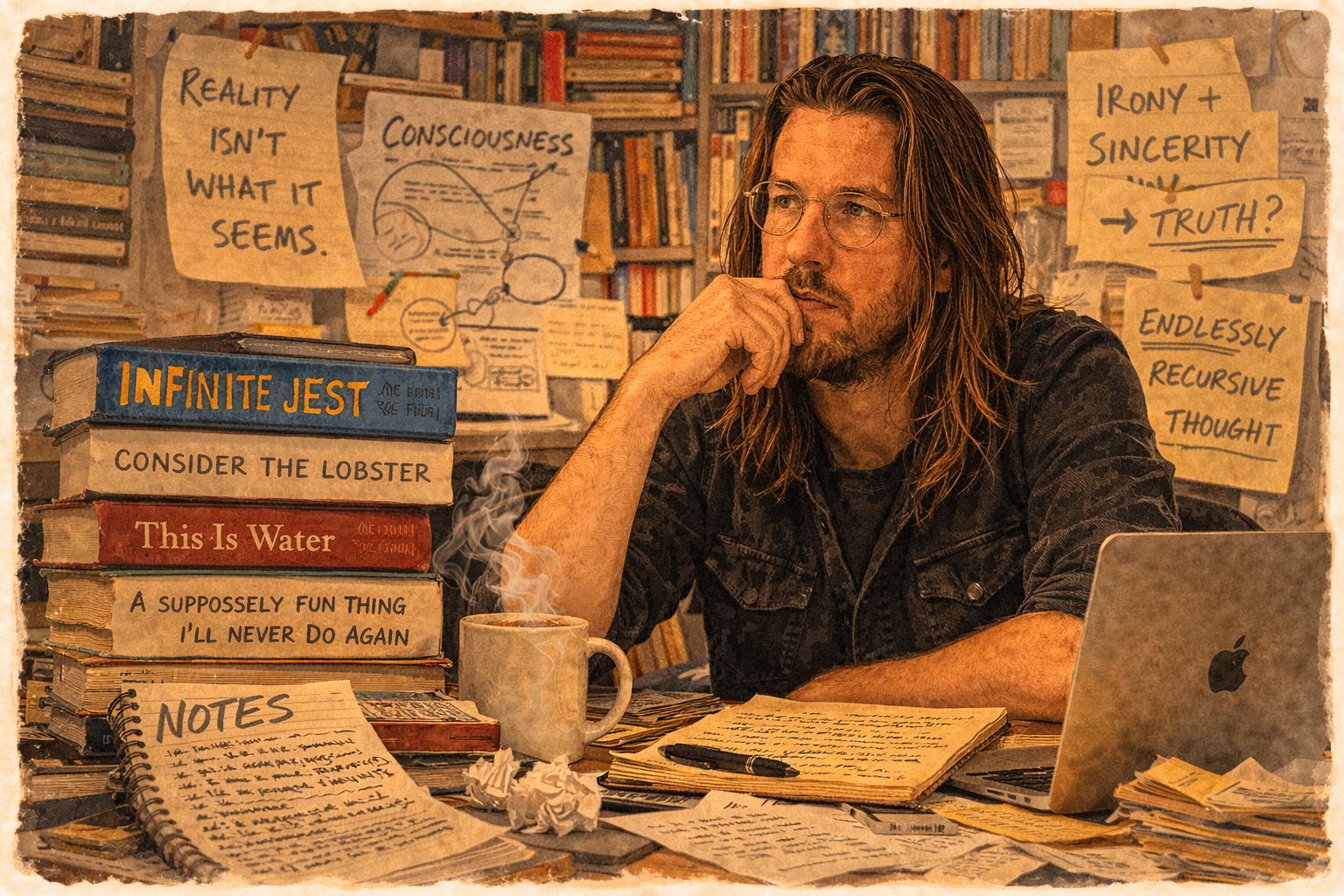
David Foster Wallace
NOVELIST AND ESSAYIST
One of the most distinctive American voices of his generation, known for his sprawling, genre-defying fiction, razor-sharp cultural criticism, and an almost unsettling ability to articulate the inner workings of modern consciousness. Wallace brought relentless intellectual honesty, deep empathy, and uncommon moral seriousness to everything from the nature of entertainment to the quiet, daily work of paying attention.