
Richard Feynman on
the Pleasure of
Finding Things Out
A Life Told in Three Movements:
Formation, Reckoning & Philosophy
of self-taught discovery
and learning to play again
and the beauty of doubt
In 1981, Feynman sat for a BBC Horizon interview that became one of the most celebrated conversations about the scientific mind ever recorded. With most of his life behind him, he reflected on everything from his father's teaching to the moral weight of the atomic bomb to the pure pleasure of not knowing.
The Beauty of a Flower
An artist says science destroys beauty. Feynman disagrees: understanding the cell structure, evolution, and color perception only deepens the wonder.
Naming vs. Knowing
His father taught him that knowing a bird's name in every language tells you nothing about the bird. Real knowledge means observing how the world actually works.
Self-Taught Algebra
While his cousin struggled under a tutor, Feynman learned algebra and calculus on his own, driven not by curriculum, but by the desire to find things out.
Epaulettes & the Pope
His father pointed out that the Pope is just a man in a special uniform. This irreverence toward authority shaped Feynman's lifelong distrust of honors and titles.
The Manhattan Project
Feynman joined the bomb project to protect civilization, but never reconsidered when the original reason, the German threat, disappeared. He calls this his immorality.
Success & Suffering
After Hiroshima, Feynman fell into depression. Sitting in Manhattan, he mentally mapped the blast radius and became convinced all civilization was doomed.
Freedom from Expectation
Realizing he didn't have to live up to others' expectations, he started playing with physics again, and this playfulness led directly to his Nobel Prize work.
The Nobel Prize
He found the prize irritating. The real reward was the discovery itself. He resigned from the National Academy of Sciences for its obsession with gatekeeping membership.
The Rules of the Game
Physicists are like spectators watching gods play chess, deducing rules from observed patterns, always excited when something doesn't fit the theory.
Science vs. Pseudoscience
Social sciences often follow the forms of real science without achieving genuine results. Self-proclaimed experts intimidate the public with authority they haven't earned.
Doubt & Uncertainty
Feynman closes with a defense of not-knowing. Having approximate answers and living with doubt is far more interesting than having answers that might be wrong.
Feynman opens the interview not with physics, but with an argument about a flower. An artist friend claims that science strips beauty from the world. Feynman sees it the opposite way: a scientist can appreciate the same surface beauty, but also perceives the cells within, the evolutionary processes that shaped the colors, and the question of whether insects can see beauty too. For Feynman, science only adds. It never subtracts.
The Artist's Claim
- I can see the beauty of this flower
- But you, as a scientist, take it apart
- You reduce it to dull components
- Dissection destroys what makes it beautiful
Feynman's Response
- I can appreciate the same beauty you see
- But I also see beauty at smaller scales
- The evolved color, the cells, the processes
- Science adds wonder, it doesn't subtract
The most powerful formative influence was his father, Melville Feynman, a uniform salesman with no formal science training, but a gift for translating the abstract into the tangible. Reading from the Encyclopaedia Britannica, Melville didn't just relay facts; he brought them to life. A dinosaur wasn't twenty-five feet tall; it was tall enough to poke its head through the bedroom window.
The Naming Lesson
Walking in the woods, a boy asked young Richard if he knew what kind of bird they'd seen. Richard didn't. The boy was shocked, as his own father had taught him the bird's name in a dozen languages. But Feynman's father had taught him the opposite lesson:
- You can know a bird's name in every language on Earth and still know nothing about the bird itself.
- Instead: observe its behavior, watch what it does, ask why it pecks, that is real understanding.
- The same principle applied to the ball in the wagon, his father explained inertia not as a name, but as a deep mystery nobody truly understands.
Understanding
Self-Taught Calculus
The difference is the epaulettes, it was always the uniform, the position. But this man has the same human problems, he eats dinner like anybody else. Why are they all bowing to him?
Feynman, recounting his father's words about the PopeThe interview takes a darker turn as Feynman describes how his PhD work was interrupted by an invitation to join the Manhattan Project. What followed, the moral compromises, the celebration at Los Alamos while Hiroshima burned, the years of depression, would reshape his relationship with science, success, and himself.
I would see people building a bridge and I would say "they don't understand." I really believed that it was senseless to make anything because it would all be destroyed very soon anyway.
Feynman, on his post-Hiroshima depressionWhy He Disliked Honors
- Honors are like uniforms; people bow to them for the wrong reasons
- The Arista club in high school spent all its time choosing who was "worthy"
- The National Academy of Sciences was the same gatekeeping instinct
- Being honored steals time from doing actual science
What He Valued Instead
- The kick of the discovery, the moment you see something new
- Watching other physicists use and build on his work
- The freedom to play with ideas without pressure
- Doing physics for the sheer pleasure of finding things out
The final act of the conversation lifts into Feynman's philosophy of science itself: how physics works, why pseudoscience is dangerous, and why the willingness to not know is perhaps the most important intellectual virtue of all.
♟️ The Rules of the Game: Physics as Cosmic Chess
see the pieces move
the patterns you see
everything gets rethought
are simpler, not harder
Feynman's favorite analogy: physicists are watching gods play chess, trying to figure out the rules just by observing. The thrilling part? Unlike real chess, every deeper layer of physics reveals greater simplicity beneath apparent complexity.
From Hundreds of Particles to Deeper Unity
Each layer reveals greater simplicity beneath the complexity
Feynman turns a sharp eye toward fields that wear the costume of science without practicing its discipline. Social sciences, he argues, too often follow the forms of scientific inquiry, gathering data, running studies, without achieving genuine results. Meanwhile, self-proclaimed experts sit at their typewriters making unverified claims about nutrition, health, and food, intimidating the public with the authority of science they haven't earned.
Pseudoscience
- Follows the forms of science without achieving results
- Gathers data, publishes papers, claims expertise
- Hasn't discovered laws or produced reliable findings
- Experts who haven't done the checks or the care
Real Science
- Demands rigorous experimentation and replication
- Accepts uncertainty; invites being proven wrong
- Understands how easy it is to fool yourself
- Knows what it means to truly know something
In His Own Words
I can live with doubt and uncertainty. I think it's much more interesting to live not knowing than to have answers which might be wrong.
Science knowledge only adds to the excitement and mystery and the awe of a flower. It only adds; I don't understand how it subtracts.
On BeautyYou can know the name of a bird in all the languages of the world, but when you're finished, you'll know absolutely nothing about the bird.
On Naming vs. KnowingThe prize is the pleasure of finding the thing out, the kick in the discovery. The honors are unreal to me.
On the Nobel PrizeI don't have to be good because they think I'm going to be good. And I could relax about this.
On FreedomWhat I did, immorally, was to not remember the reason that I said I was doing it, so that when the reason changed, I didn't reconsider.
On the Bomb📺 The Interview
This conversation was filmed in 1981 for the BBC program Horizon and later aired as an episode of Nova in the United States. Feynman was 63, with most of his life behind him. He would die seven years later in 1988. The interview captures an unusually candid Feynman, relaxed, reflective, and willing to discuss everything from childhood memories to his deepest regrets.
📘 Why It Endures
Few interviews so elegantly capture the full arc of a scientific life, the childhood wonder, the moral compromises, the pursuit of knowledge for its own sake, and the courage to embrace uncertainty. Feynman's insistence that not knowing is more interesting than false certainty feels as vital now as it did four decades ago.
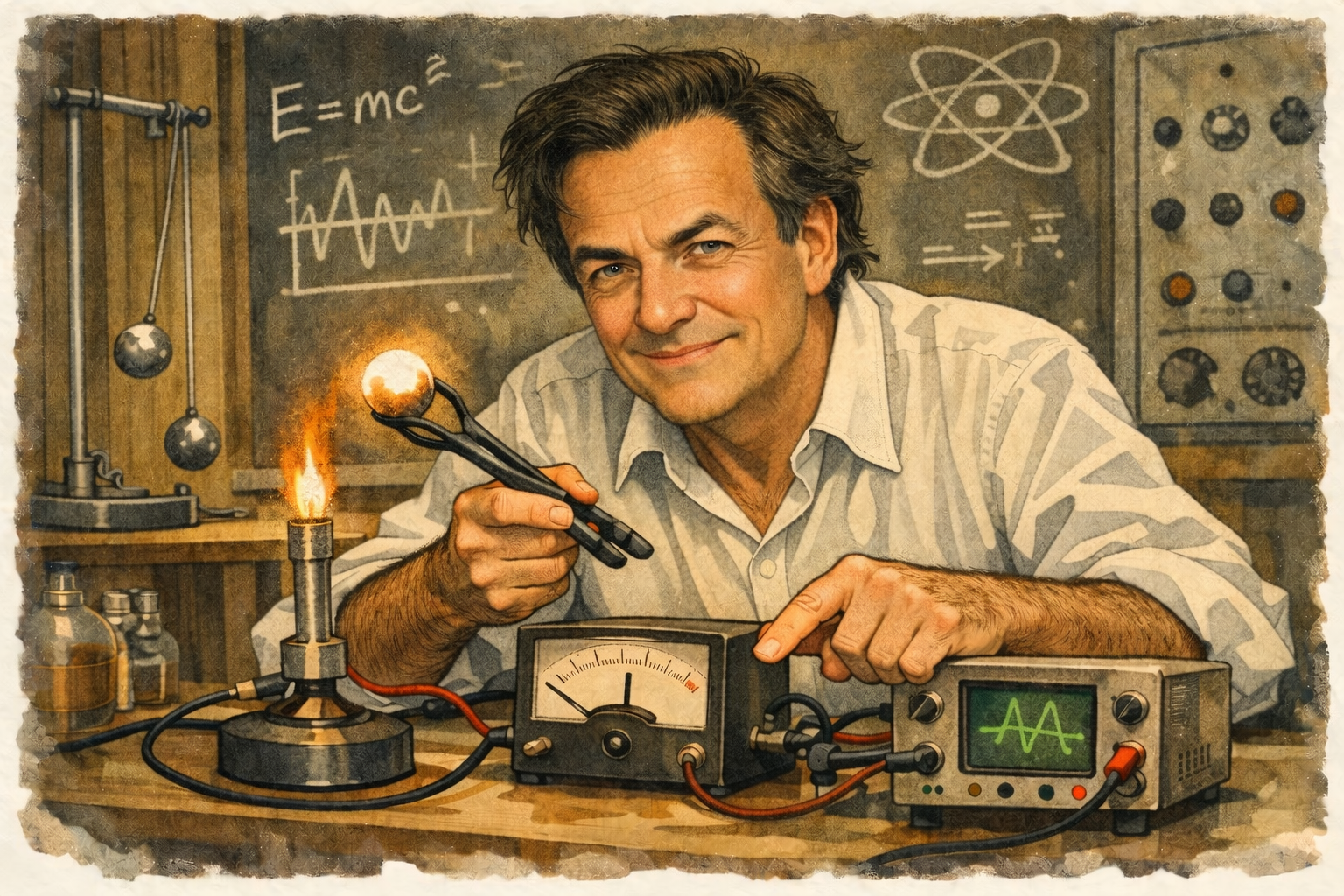
Richard Feynman
THEORETICAL PHYSICIST AND NOBEL LAUREATE
One of the most influential physicists of the twentieth century, known for his pioneering work in quantum electrodynamics, his role in the Manhattan Project, and his legendary gift for making complex ideas accessible. Feynman brought boundless curiosity, irreverence, and clarity to everything from subatomic particles to the nature of knowledge itself.