
Charlie Munger on
the Psychology of
Human Misjudgment
Charlie Munger didn't study psychology formally. Instead, he built his own system from personal experience, observation, and casual reading over decades. Late in life, he discovered Robert Cialdini's "Influence," which filled in the holes and validated what he'd already learned through living.
This is the core insight: Psychology and economics must be reconciled. Behavioral economics isn't an optional elective; it's foundational to understanding human decision-making. If you want to understand why people do what they do, why they invest poorly, why they sign bad contracts, why they make predictable mistakes, you must understand the 24 standard causes of misjudgment that shape human behavior.
These tendencies evolved for good reason. They're mostly adaptive shortcuts that helped our ancestors survive. But when they misfire, especially in combination, they produce catastrophic errors in judgment.
Six Categories of Cognitive Bias
Incentives & Reinforcement
People do what they're incentivized to do. FedEx fixed overnight delivery by paying shifts, not hours.
Psychological Denial
Reality too painful to bear? The mind distorts it until it's endurable.
Incentive-Caused Bias
Your trusted advisor's thinking is warped by what's good for him, not you.
Consistency & Commitment
The mind locks in like a fertilized egg. Once committed, you resist all disconfirming evidence.
Pavlovian Association
Three-quarters of advertising is pure Pavlov. Coca-Cola sells associations, not caffeine.
Persian Messenger Syndrome
Kill the messenger who brings bad news. Leaders end up in a cocoon of unreality.
Reciprocation Tendency
Ask big, then back off to what you really want. Compliance triples.
Social Proof
Nobody helped Kitty Genovese because nobody else was helping. We follow the crowd.
Contrast Effect
A frog in slowly heating water won't jump. We judge by comparison, not absolutes.
Authority Bias
In flight simulators, 25% of copilots let the plane crash rather than contradict the pilot.
Deprival Super-Reaction
New Coke triggered riots. Loss is felt far more intensely than equivalent gain.
Envy & Jealousy
Two of the Ten Commandments target envy. It's not greed that drives the world; it's envy.
Chemical Dependency
Always causes moral breakdown. Always involves massive denial.
Gambling Compulsion
Pick-your-own-number lotteries get huge play. Slot near-misses exploit deprival super-reaction.
Liking Distortion
We especially like ourselves, our own kind, and our own ideas, and are misled by those we like.
Disliking Distortion
The reciprocal of liking. We fail to learn from people we dislike.
Non-Mathematical Brain
We use crude heuristics instead of Fermat and Pascal. Think like Zeckhauser plays bridge.
Extra-Vivid Evidence
Munger lost $30 million by overweighting one CEO's vivid peculiarities.
Failure to Array in Theory Structures
If you don't ask 'why,' you cannot handle the world. Feuerstein's failure at Solomon Brothers.
Limits of Sensation & Cognition
Normal limitations of memory, perception, and knowledge that we all carry.
Stress-Induced Changes
Pavlov's flood reversed his dogs' conditioned behavior. Extreme stress rewires the brain.
Mental Decline & Disuse
Abilities attenuate with disuse. Other mental illnesses compound the problem.
Say-Something Syndrome
Like the honeybee who can't communicate and does an incoherent dance instead of staying quiet.
Lollapalooza Effect
When multiple biases combine, power doesn't add, it multiplies. The most important concept.
Munger has spent 70 years studying incentives. The conclusion? People do what they're incentivized to do. This is not a minor observation. It explains most human behavior, and it's predictable.
The Perversity Problem
After the defense department had enough experience with cost-plus-percentage-of-cost contracts, the reaction of the republic was to make them a felony. But much of the world, including most law firms, still runs on the same system. And Westinghouse blew two or three billion dollars pre-tax making 100% loans to hotel developers, because the accounting showed wonderful results in the initial phase of every transaction.
The cash register was a great moral instrument when it was created. Patterson had a little store where people were stealing him blind. He bought a couple of cash registers, went to profit immediately, closed the store, and went into the cash register business. Institutions that make misbehavior hard are among the effective saints of our civilization.
People who create things like cash registers, which make misbehavior hard, are some of the effective saints of our civilization.
Charlie MungerReinforcement & Incentives
FedEx couldn't get the night shift to move packages fast enough. They tried moral suasion, they tried everything. Then somebody got the happy thought that they were paying by the hour. When they switched to paying by the shift, the system worked. At Xerox, Joe Wilson couldn't understand why their better new machine was losing to the inferior old one, until he found the commission arrangement gave salesmen a tremendous incentive to sell the wrong machine.
Incentive-Caused Bias
A doctor in Lincoln, Nebraska sent bushel baskets of normal gallbladders to the pathology lab for five years. Did he think he was committing fraud? No, he genuinely believed the gallbladder was the source of all medical evil. Incentive-caused bias warps judgment in your own mind and in your trusted advisor's, creating what economists call agency costs. In 70 years, Munger has never seen a commercial real estate sales presentation within hailing distance of objective truth.
Once you commit to something, and once you take a public position, your mind locks down like a fertilized egg. Munger calls this "the human egg effect." The scientist Max Planck observed that science advances one funeral at a time: old paradigms don't change, they die with their defenders. But you don't need to wait for death. The commitment trap operates on much shorter timescales.
The Chinese understood this better than anyone. Their brainwashing technique didn't rely on torture or mind control. They simply got prisoners to make small written confessions, then slightly larger ones, then larger still. By the time they'd written major confessions, their minds had reorganized around those statements. The ideas pounded into your own head have enormous power.
What You Think Changes What You Do
- Limited influence on behavior
- Easy to change opinion
- Thoughts stay private
What You DO Changes What You THINK
- Massive behavioral power
- Hard to reverse
- Public commitment is binding
Many of these students that are screaming at us, they aren't convincing us, but they're forming mental chains for themselves. What they're shouting out, they're pounding in.
Charlie MungerLimits of Sensation & Cognition
Your sensory apparatus has built-in blind spots (for instance, magicians exploit contrast troubles to remove your watch without you noticing). The mind can't perceive everything. But availability dramatically shapes behavior: when Coca-Cola made their product consistently available, consumption skyrocketed. Your perception is not reality; it's what gets through your attention filter.
Stress-Induced Changes
Pavlov's great discovery came from disaster. During the Leningrad flood, dogs in cages faced maximum stress while water rose around them. When the water receded and they survived, every one of them had undergone total reversal of their conditioned personality. Extreme stress obliterates learned behavior patterns and can reshape the mind fundamentally.
Emotions are powerful drivers of behavior, often more powerful than logic. Three emotional biases account for enormous amounts of human suffering and poor decision-making.
Denial, Deprival, and Envy
Denial: A family friend had a super-athlete, super-student son who flew off a carrier in the North Atlantic and never came back. His mother, a very sane woman, simply never believed he was dead. And on television, the mothers of the most obvious criminals always think their sons are innocent. The reality is too painful to bear, so the mind distorts it until it's endurable.
Deprival Superreaction: Coca-Cola had the most valuable trademark in the world, tied to a specific flavor for nearly a century, and then they told people they were changing it. Goizueta and Keough committed pluperfect insanity. The deprival super-reaction was so extreme that Pepsi was within weeks of putting Old Coke in a Pepsi bottle. Meanwhile, a neighbor's small pine tree turned a 180-degree harbor view into 179¾ degrees, and triggered a blood feud like the Hatfields and McCoys. People are really crazy about minor decrements down.
Envy: Two of the Ten Commandments directly target envy. I've heard Warren say a half a dozen times, "It's not greed that drives the world but envy." Yet if you look in the index of a thousand-page psychology textbook, under envy and jealousy, it's blank. An enormously powerful force that operates largely at a subconscious level.
Chemical Dependency
Addiction always causes moral breakdown and massive denial. The mind distorts reality to make the situation bearable; a powerful psychological defense that locks people into harmful patterns. Chemical dependency hijacks the same commitment mechanisms that bind behavior to belief, making escape extraordinarily difficult.
Liking Distortion
We especially like ourselves, our own kind, and our own ideas. And we're dangerously susceptible to being misled by people we like. This tendency runs deep and subconscious. You'll believe almost anything from someone you've grown fond of, and dismiss the same argument from someone you dislike.
Disliking Distortion
The reciprocal of liking: we fail to learn from people we dislike, no matter how correct they are. Brilliant people in conflicts get trapped in almost pathological behavior. These subconscious tendencies are powerful, basic, and deeply rooted. They override logic when activated.
Munger credits Robert Cialdini for helping him understand just how powerful social forces are. We're not rational economic actors. We're tribal creatures, deeply responsive to what others do and what authority figures say.
Persian Messenger Syndrome
The Persians really did kill the messenger who brought bad news. You think that's dead? Bill Paley didn't hear one damn thing he didn't want to hear in his last 20 years. People knew it was bad for the messenger. The leader ends up in a cocoon of unreality. Munger saw Arco and Exxon spend tens of millions in a Texas court over North Slope ambiguities, because nobody wanted to bring the bad news up the line.
Reciprocation
Cialdini asked students on campus to take juvenile delinquents to the zoo. Only one in six agreed. Then he asked others first for a much bigger commitment (two afternoons a week), got 100% refusal, and backed off to the zoo request. Compliance tripled. Just going through the ask-big-then-retreat sequence manipulates people on a subconscious level.
Social Proof
When Kitty Genovese was slowly murdered while 50 or 60 people watched, nobody did anything. Everybody looked at everybody else and nobody was acting, so social proof told them the right thing to do was nothing. Munger notes this isn't the full explanation, but it's a powerful part of it.
Authority Bias
In the Milgram experiment, a person posing as an authority figure tricked ordinary people into believing they were administering heavy electric shocks to fellow citizens (who were, in fact, actors). The subjects complied despite every reason to think they were causing real torture. And in flight simulators, when the pilot does something an idiot would know will crash the plane, 25% of the time the copilot just sits there and lets it crash.
Beyond incentives and emotions, the human mind has systematic distortions in how it processes information. These five biases explain why we make predictable errors in thinking.
Pavlovian Association
Practically three-quarters of advertising works on pure Pavlov. Coca-Cola wants to be associated with every wonderful image, heroics in the Olympics, wonderful music, never with funerals. And here's the insidious part: when you raise the price of a complex product, sales can go UP, because price-quality association acts as a Pavlovian bell.
Contrast Effect
Cialdini describes the real estate broker who first takes the rube to two of the most awful, overpriced houses, then shows a moderately overpriced one, and sticks them. Throw a frog in hot water and it jumps out, but heat it slowly and it stays put until it dies. Cognition mimics sensation. We judge by contrast, not by absolutes.
Gambling Compulsion
Skinner discovered that variable reinforcement, i.e., rewarding behavior unpredictably, drives behavior harder than any other pattern. Slot machines exploit this: bar, bar, lemon... near misses everywhere. People who design these machines understand human psychology better than most psychologists. It's Deprival Super-Reaction Syndrome weaponized.
Non-Mathematical Thinking
The right way to think is the way Zeckhauser plays bridge: applying simple probability on all available information. But the brain doesn't naturally do this. It uses crude heuristics, is misled by contrast, and overweighs conveniently available information.
Extra-Vivid Evidence
Munger himself is at least $30 million poorer because he once turned down 1,500 extra shares of a stock. The CEO had such vivid personal peculiarities that Munger overweighted them, even though the man's business situation was actually foolproof. Vivid but irrelevant evidence overwhelmed the dry statistical reality.
Not Asking "Why"
Feuerstein, Solomon Brothers' general counsel, told Gutfreund two or three times to report the misconduct. But he never told him WHY in vivid terms: you're likely to ruin your life, disgrace your family, lose your money. A Harvard Law Review member flunked elementary psychology. If you don't tell people why, your communication doesn't work.
Mental Decline Through Disuse
Abilities attenuate with disuse. What you don't practice, you lose. The mind treats skills like muscles: without exercise, they atrophy. This is why pilots need simulators and surgeons need residency programs. Continuous practice is the only antidote to this fundamental aspect of human cognition.
Say-Something Syndrome
A honeybee finds nectar and dances to tell others where it is. A scientist put nectar straight up, something never found in nature. The honeybee couldn't communicate this, so it came back and did an incoherent dance. Munger has spent his life dealing with the human equivalent: people making confident pronouncements about situations they have no genetic program to handle.
Munger: "The most important question in this whole talk: What happens when several of these tendencies act together in the same direction?"
The answer: catastrophe. The power doesn't add. It multiplies. One bias pulls you in the wrong direction. Two biases compound the error. Three or more biases all pushing the same way? You're now predictably irrational in the most damaging possible way.
How Biases Combine and Amplify
Tupperware Parties
Social proof (everyone's buying), reciprocation (the host gave a gift), commitment (you said you'd come), and authority (your friend the host) all converge. The result: women buy plastic containers they don't need.
Milgram's Experiment
Widely interpreted as mere obedience, but Munger disagrees. The experimenter gave a false explanation, "We need this for scientific truth", which greatly changed behavior. Then he started students on tiny shocks and inched them up, a little larger each time. Authority, a compelling (if false) "why," commitment and consistency, and the contrast principle. Four tendencies combined to make ordinary people believe they were torturing strangers, and keep going anyway.
McDonnell Douglas Evacuation
To certify a new airliner, the government required a realistic evacuation drill. McDonnell Douglas put elderly passengers on rubber chutes in a dark hangar, 25 feet up. The morning test produced 20 terrible injuries and failed the time requirement. So what did these brilliant engineers do? They ran it again that afternoon, resulting in 20 more injuries and one severed spinal column with permanent paralysis. Authority said do it, they'd already committed to doing it twice, and passing meant selling the plane. Multiple tendencies turned smart people into mush.
Open-Outcry Auctions
Social proof (the other guy is bidding), reciprocation tendency, and deprival super-reaction (the thing is going away) all combine. It's absolutely designed to manipulate people into idiotic behavior. Warren Buffett's rule: don't go.
Understanding the biases is half the battle. The other half is building systems and habits that protect you from them. These are Munger's proven antidotes.
Karl Braun's Five W's
Karl Braun required who, what, where, when, and WHY in every communication. You got fired at the Braun Company if you left out the why. Always ask why.
Flight Simulators
Abilities attenuate with disuse, that's one of Munger's 24 causes. The simulator is God's gift to pilot training because it keeps skills fresh. A constructive use of understanding that the human mind loses what it doesn't practice.
Alcoholics Anonymous
AA works because it uses commitment devices (public declarations), social proof (the group), reciprocation (helping others), and consistent practice. It's a Lollapalooza of good incentives.
Clinical Training
"Watch one, do one, teach one." Learning by doing, with feedback loops, is far superior to lectures. Teaching forces you to organize knowledge and face gaps in understanding.
Constitutional Convention
The Convention kept deliberations totally secret with no recorded votes until the final vote. This prevented people from being locked in by public declarations, fighting consistency & commitment tendency.
Granny's Rule
"You don't get the ice cream unless you eat your carrots." A very eminent psychologist teaches executives to organize their day: force yourself to do the unpleasant and important things first, then reward yourself with something you like. Granny was a very wise woman.
Decision Trees
Munger used to laugh at Harvard Business School for teaching 28-year-olds that high school algebra works in real life. Then he wised up, realizing that using elementary probability and decision trees to think through problems is profoundly important. Better late than never.
Post-Mortems
At most corporations, when an acquisition turns into a disaster, all the paperwork is quickly forgotten (denial, Pavlovian association, nobody wants to be associated with it). At Johnson & Johnson, they make everybody revisit old acquisitions and wade through the original presentations. Munger does the same thing routinely.
Darwin's Disconfirmation Method
Actively seek evidence against your position. Darwin made a practice of this. Confirmation bias is automatic. Disconfirmation requires discipline. Create "hair shirts", uncomfortable reminders to consider the opposite.
In His Own Words
📖 The Source
This lecture was delivered by Charlie Munger, Vice Chairman of Berkshire Hathaway, to an audience of behavioral economists at Harvard. Munger never formally studied psychology. Instead, he built his own system from decades of personal experience, casual reading, and the work of Robert Cialdini. The result is his catalog of 24 standard causes of human misjudgment, a framework he credits with helping him navigate both investing and life.
🔥 Why It Endures
Most psychology lectures stay in the lecture hall. This one escaped. Munger's talk became foundational reading in behavioral finance, decision science, and business education, not because of academic rigor, but because of its relentless practicality. Every bias comes with a story from real life: FedEx night shifts, Coca-Cola disasters, billion-dollar lawsuits. The framework sticks because it was built to be used, not to be published. Decades later, it remains one of the most shared and cited talks on human judgment ever given.
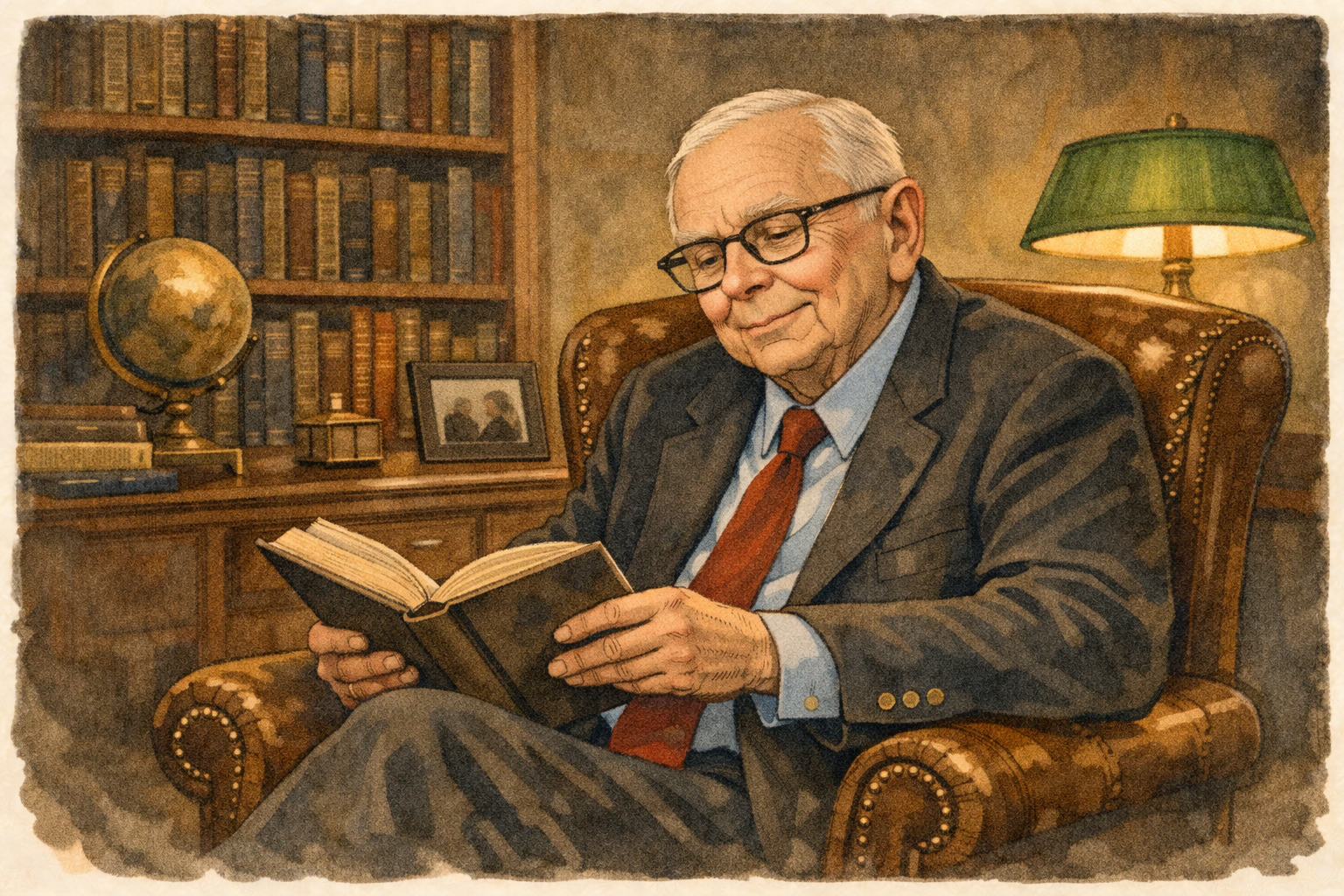
Charlie Munger
INVESTOR AND POLYMATH
One of the most respected minds in the history of investing, known for his six-decade partnership with Warren Buffett, his lattice of mental models drawn from every discipline imaginable, and a talent for distilling hard truths into memorable, often biting, one-liners. Munger brought ferocious rationality, intellectual breadth, and a contrarian's disdain for foolishness to everything from capital allocation to the psychology of human misjudgment.